

Spear Phishing vs. Whaling: Key Differences & Defenses
Learn the critical differences between spear phishing vs whaling. Assess risks and build strong executive defenses against high-stakes social engineering.
Spear Phishing vs. Whaling: Key Differences & Defenses
Learn the critical differences between spear phishing vs whaling. Assess risks and build strong executive defenses against high-stakes social engineering.
Null Cipher Security
7/3/202611 min read
“Use better email filtering and train users to spot suspicious emails” is the most common advice in the spear phishing vs whaling debate. It's also incomplete.
That guidance helps with commodity phishing. It doesn't address how a determined operator works when the target is a CFO, CEO, board member, or executive assistant. In real attacks, and in adversary simulations, whaling rarely looks like a slightly better phishing email. It looks like a business process attack wrapped in executive authority, urgency, and timing.
Security leaders often treat whaling as just a subset of spear phishing. The taxonomy is technically fine. The defensive conclusion is where teams get into trouble. Once an attacker decides to target the C-suite, the playbook changes. Research gets deeper. Pretexting gets tighter. Communication moves beyond email. Approval workflows become the primary target.
That's why the practical question isn't just what spear phishing and whaling mean. It's what the attacker has to do differently to make each one work, and what your organization has to change to stop it. Teams that want more context on attacker-led security thinking can find related perspectives in the Valiant Cyber blog.
Beyond the Buzzwords Understanding the Real Threat
Most organizations still frame spear phishing vs whaling as a matter of rank. One goes after employees. The other goes after executives. That definition is accurate, but it's not useful enough for a CISO making control decisions.
The distinction sits in attacker investment and attack design. A spear phishing campaign usually aims to gain access, steal credentials, plant malware, or create a foothold through a specific employee or team. A whaling campaign aims to exploit executive authority itself. The attacker wants a decision, an approval, a transfer, a disclosure, or a shortcut around process.
That shift changes everything. The operator doesn't just ask, “Who will click?” The operator asks, “Who can move money, approve legal action, disclose strategic documents, or pressure others into skipping verification?”
Practical rule: If your defense plan treats executive impersonation as an email problem, you're defending the wrong layer.
From an offensive perspective, spear phishing often targets where access lives. IT admins, HR, payroll, finance staff, and department managers all make sense because they can provide access to credentials or systems. Whaling targets where authority lives. That means the attacker studies not only the executive, but also the executive's assistant, finance approvers, legal contacts, and trusted vendors.
Three operational realities matter most:
Access attacks and authority attacks differ. Spear phishing often seeks entry. Whaling often seeks action.
The human target is wider than the named victim. A CEO may be the impersonated identity, while the actual recipient is a controller or assistant.
Business context is the payload. The strongest lure isn't malware. It's a request that fits the rhythm of the business.
CISOs who separate these two problems usually build better controls. CISOs who collapse them into one awareness topic usually leave a gap around executive workflows, high-trust communications, and urgent approvals.
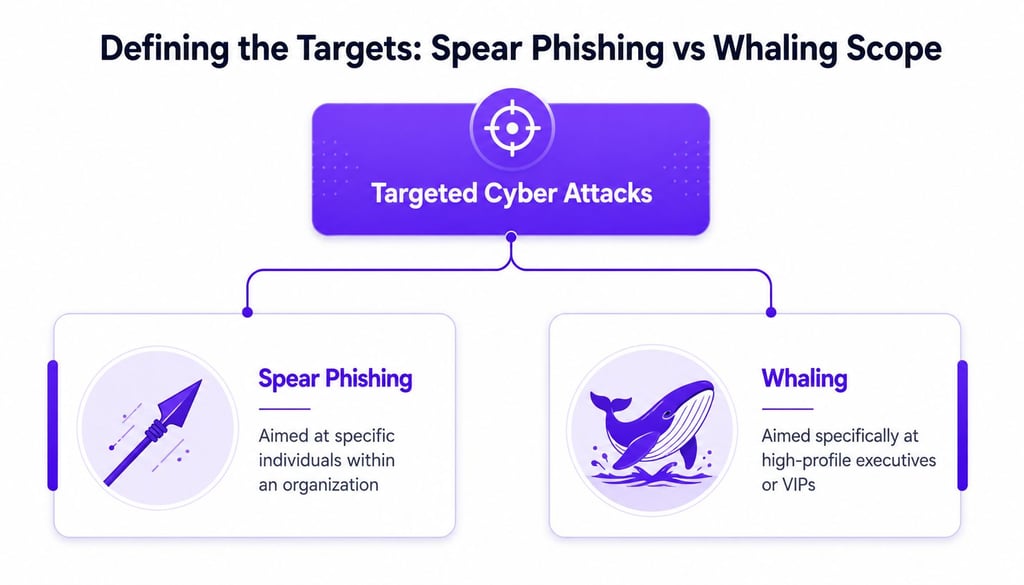
Defining the Targets Spear Phishing vs Whaling Scope
The cleanest way to understand spear phishing vs whaling is to focus on scope and intent.
Spear phishing is a targeted attack against a specific person, role, or team. The attacker may go after accounting, HR, an IT administrator, or a project manager. The objective is usually tactical. Steal credentials. Deliver malware. Gain a foothold. Move laterally after initial access.
Whaling is narrower and more strategic. It goes after the “big fish.” That means senior executives and others with comparable authority, such as CEOs, CFOs, founders, board members, and finance leaders. The attacker isn't just looking for access. The attacker wants the power attached to that account or identity.
The line that matters
A useful baseline comes from LastPass's breakdown of spear phishing and whaling, which notes that spear phishing targets general employees while whaling targets C-suite executives, and that both rely on advanced social engineering to trick recipients into revealing credentials, installing malware, or granting system access.
That distinction sounds simple. In practice, it shapes the whole operation. If the target is an employee, the attacker often wants entry. If the target is an executive, the attacker often wants the shortcut that authority creates.
A practical way to separate them
Think about it this way:
Spear phishing is access-oriented. An attacker picks a person who can open the door.
Whaling is authority-oriented. An attacker picks a person who can sign, approve, authorize, or pressure others.
That's why the same company can face both attacks at the same time. One campaign may target an IT admin with a Microsoft 365 lure to capture credentials. Another may impersonate the CEO in a confidential payment request to finance. Both are targeted. Only one is whaling.
A useful mental model is this. Spear phishing compromises the path into the business. Whaling compromises the business decision itself.
Why target scope changes defense
A targeted campaign against a department can often be reduced by better identity controls, tighter endpoint policy, and role-based awareness. Whaling doesn't yield as easily because the attacker exploits executive behavior and organizational trust.
Executives work under time pressure. They delegate. They handle confidential matters. They approve exceptions. Attackers know this. They build pretexts around acquisitions, legal issues, board reviews, payroll issues, vendor changes, and urgent transfers because those subjects already justify speed and discretion.
If you only ask who received the message, you'll miss the core issue. Ask who had the authority to make the requested action happen.
An Attacker's Playbook Key Tactical Differences
When defenders compare spear phishing vs whaling, they often stay at the label level. Operators don't. They care about how much reconnaissance is needed, which channels carry the pretext best, and what action the target can take without much scrutiny.
A practical comparison makes that clearer.
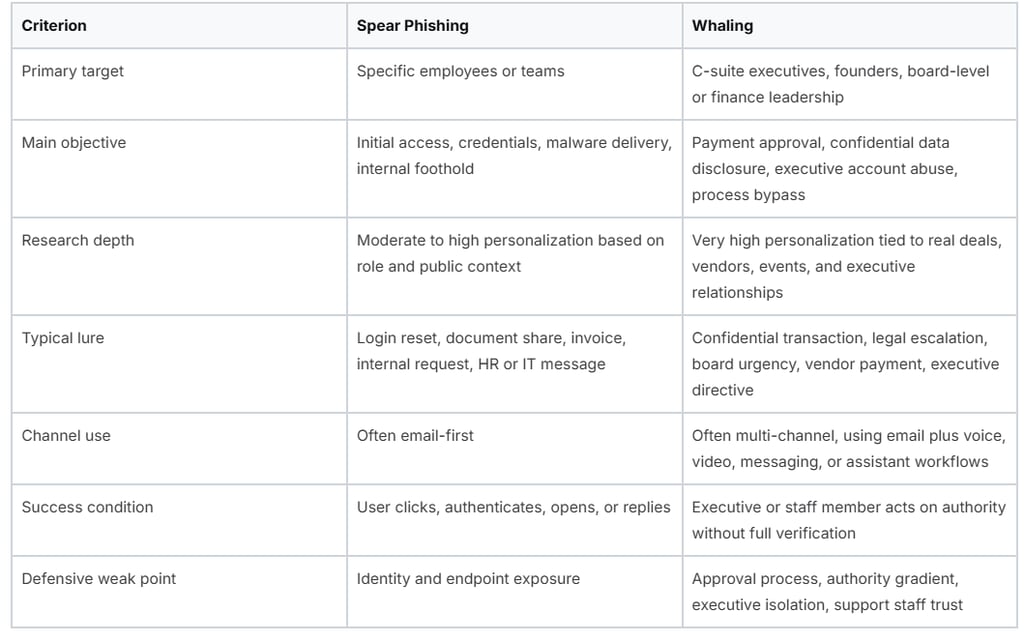
Spear Phishing vs Whaling A Tactical Comparison
A source that captures the core split well is DCG Technical Solutions' comparison of phishing, spear phishing, and whaling, which states that the primary feature distinction lies in target scope and research intensity. Spear phishing uses moderate-to-high personalization against individuals or departments, while whaling focuses on executives with very high research intensity and often references real deals, vendors, or industry events.
Recon changes the whole attack
For standard spear phishing, an operator may use public details like job role, recent activity, team structure, or vendor names. That's enough to create a convincing Microsoft 365 prompt, payroll update, or shared-document lure.
For whaling, that level of prep usually isn't enough. The attacker needs business context that survives executive scrutiny. That can include a current transaction, a known law firm, a board meeting cadence, a real travel schedule, or the name of an executive assistant who normally brokers requests.
That's why whaling tends to feel less like phishing and more like impersonation-backed fraud.
The delivery model also shifts
Spear phishing often works as a single event. One message. One link. One attachment. One login page.
Whaling often works as a sequence. An executive gets an email. Finance gets a follow-up. The assistant gets a text. A voice call arrives to reinforce urgency. The attacker uses every touchpoint to make the request feel expected.
Many security programs fall short. They test the inbox but not the process. Teams that want to assess that broader exposure usually need penetration testing and vulnerability assessment services that include human and workflow-driven attack paths, not just technical findings.
What works for attackers
In practice, the strongest whaling pretexts share a few traits:
They fit a normal business motion. Payment approval, contract review, or document release.
They justify urgency. Legal deadlines, vendor escalation, or confidential transactions.
They reduce social friction. “Handle this directly” or “don't delay the deal.”
They exploit proximity to power. Executive assistants and finance teams often become the true execution path.
That's why “be cautious with suspicious emails” isn't enough. The operator isn't trying to look suspicious. The operator is trying to look operational.
Measuring the Damage The Business Cost of a Breach
A successful spear phishing incident and a successful whaling incident can both hurt the organization. They don't hurt it in the same way.
A spear phishing compromise often starts a chain. An employee enters credentials into a fake Microsoft 365 page. The attacker accesses email, pivots to internal systems, and expands control. From there, the incident can turn into account takeover, internal phishing, ransomware staging, or data theft. The impact grows as the attacker moves.
A whaling event often lands differently. The attacker uses an executive identity, or targets one directly, to trigger an immediate business action. Finance sends funds. Legal shares confidential documents. An assistant releases a file to the wrong party. The damage can become material before the SOC even sees the event.
Two scenarios CISOs should model
Scenario one is classic spear phishing. An attacker lures an IT administrator with a credential harvest tied to a routine cloud login. The admin authenticates. The attacker gains privileged access, creates persistence, and uses trusted systems to expand reach. The breach becomes an infrastructure problem.
Scenario two is whaling. A CFO receives what appears to be a confidential executive request tied to a transaction. The message pushes speed and discretion. The request bypasses normal review because it appears to come from the top. The breach becomes a finance and governance problem.
Torq's explanation of whaling phishing captures this business angle well. It describes whaling as a high-stakes subcategory of spear phishing that targets or impersonates C-suite executives to deceive them into authorizing wire transfers or sharing confidential information, often through urgent requests that bypass normal verification.
The most expensive phishing event in your business may not involve malware at all. It may involve an employee following what looks like a legitimate executive instruction.
Why boards care more about whaling
Spear phishing usually maps to cyber risk categories boards already understand. Downtime. Incident response. recovery effort. Data exposure. Whaling hits a different nerve because it exposes how easily authority can override control.
That's why whaling deserves its own tabletop scenarios. Don't model only inbox compromise. Model false urgency, executive unavailability, assistant delegation, vendor pressure, and finance staff hesitation to challenge leadership.
A short explainer can help align technical and non-technical stakeholders before those exercises:


Why Your Standard Phishing Defenses Are Not Enough
Email gateways still matter. Awareness training still matters. They just don't solve the whole whaling problem.
The issue is simple. Whaling often bypasses the inbox as the sole control point. According to Emsisoft's review of phishing, spear phishing, and whaling attacks, 68% of high-value whaling attempts involved voice or video impersonation in 2024 to 2025. That's a major operational difference. It means many serious attacks now rely on channels that standard phishing controls were never built to stop.
Why the gateway misses the real attack
A secure email gateway can block spoofed messages, bad links, and known malicious patterns. It can't reliably stop a finance employee from trusting a convincing phone call that reinforces an earlier message. It can't stop an executive assistant from acting on a request that matches current business context. It can't resolve authority pressure inside a rushed approval chain.
Whaling exploits human process gaps, not just technical gaps.
That's why generic phishing simulations often underperform with executives. Most simulations test whether someone clicks a suspicious link. Real whaling tests whether someone will break process when the request appears confidential, urgent, and high-status.
What doesn't work well
These patterns routinely fail against mature whaling tradecraft:
One-size-fits-all awareness modules. Executives don't process risk the same way frontline staff do.
Email-only simulation programs. They miss calls, texts, assistant workflows, and calendar-linked pretexts.
Ad hoc verification habits. “Just call to confirm” breaks down when the attacker controls pace and framing.
Tool-first decision making. Buying another filter won't fix a finance process that allows exceptions without challenge.
Whaling succeeds when the attacker can turn trust and urgency into an approval workflow. That's a process failure with a cyber trigger.
What attackers count on
Attackers know executives often operate with less friction than everyone else. They travel. They use mobile devices. They delegate inbox management. They handle sensitive matters outside normal channels. They can demand exceptions and receive them quickly.
That means defenders need to stop asking only, “Would our email stack catch this?” They also need to ask:
Can finance verify a request without relying on the same channel?
Will an assistant challenge a message that appears to come from the CEO?
Can legal, payroll, and treasury pause a sensitive action without political fallout?
Will the SOC know when an attack shifts from email to voice or collaboration tools?
If the answer to those questions is unclear, your phishing program probably addresses spear phishing better than whaling.
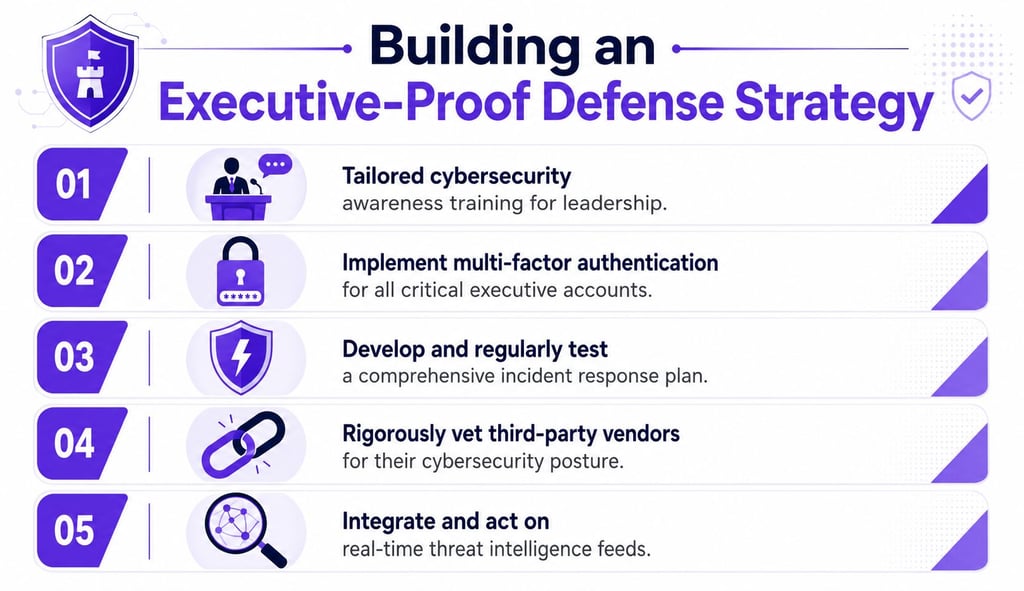
Building an Executive-Proof Defense Strategy
Stopping whaling requires a different operating model. You still need the basics, but the decisive controls sit in verification design, executive behavior, and realistic adversary simulation.
Huntress's guide to spear phishing vs whaling highlights the current pressure point well. It notes that 42% of whaling attacks in emerging 2025 to 2026 trends spoof internal executive identities using AI-generated tone and email headers that are difficult to distinguish from legitimate data, and it argues that organizations need dynamic, scenario-based red team exercises for executives and support staff.

Build controls around decisions, not just messages
Start with the decisions that can create outsized damage. Wire approvals. bank detail changes. payroll changes. legal document release. M&A information sharing. privileged account resets.
Then harden those decisions with explicit rules:
Out-of-band confirmation: Require verification through a separate trusted path for sensitive approvals.
Named backup approvers: If the executive is unavailable, route to predefined alternates rather than improvised workarounds.
No single-channel authority: Don't let email alone trigger high-risk financial or legal actions.
Assistant-safe escalation: Give executive assistants and chiefs of staff a formal path to challenge unusual requests without friction.
Those controls work because they target the attacker's win condition. The attacker doesn't need perfect impersonation. The attacker only needs your process to accept urgency as proof.
Train the executive ecosystem
Executive protection isn't only about the executive. It includes assistants, finance managers, controllers, treasury, legal, payroll, and anyone who handles privileged requests coming from leadership.
That training should be role-specific. A CFO needs one kind of scenario. An executive assistant needs another. A controller needs a third. Generic anti-phishing content rarely covers these nuances.
Use practical examples in workshops:
A CEO asks for a confidential vendor payment while traveling.
A board-related file request arrives outside normal channels.
A voice call reinforces an email requesting account changes.
A legal deadline is used to pressure an exception.
The goal isn't to make people suspicious of everything. It's to make them consistent under pressure.
Operator insight: The strongest control in whaling defense is a verification habit that survives status, speed, and secrecy.
Simulate the attack the way the adversary would
Many programs need to mature in this area. If your exercise consists only of fake emails, you're not testing whaling. You're testing a narrow sliver of it.
A serious simulation should test:
Pretext quality. Does the message align with active business context?
Channel pivoting. What happens when the attacker adds voice, messaging, or assistant contact?
Authority pressure. Will staff challenge executive directives that feel urgent?
Control resilience. Do approvals stop when verification fails, or do people find shortcuts?
Detection and response. Does anyone spot the pattern before the action completes?
Organizations that want a mature program typically need a mix of technical controls, process redesign, and realistic exercises. That's where Null Cipher Security aligns well for teams that need adversary-simulated testing and executive-level security advisory, rather than another generic awareness package.
The main takeaway is straightforward. Defending against spear phishing reduces the chance of compromise. Defending against whaling reduces the chance of catastrophic executive misuse. You need both, but you shouldn't build them the same way.
Null Cipher Security helps organizations test the risks that matter most. If you need adversary-simulated assessments for executive workflows, phishing-resistant approval processes, red team exercises, or broader offensive security validation, visit Null Cipher Security