

Penetration Testing and Vulnerability Assessment: Penetration
Understand penetration testing and vulnerability assessment. This executive guide helps you choose the right approach to reduce risk & meet compliance.
Penetration Testing and Vulnerability Assessment: Penetration
Understand penetration testing and vulnerability assessment. This executive guide helps you choose the right approach to reduce risk & meet compliance.
Null Cipher Security
7/1/202610 min read
Vulnerability Assessment vs. Penetration Testing at a Glance
You're probably in a familiar position right now. Your board wants a clear answer to a simple question: are we secure? Your security team has scan reports, dashboards, and a list of findings. But none of that tells you what an attacker could do if they got in.
That gap is where many programs stall. Leaders treat vulnerability assessment and penetration testing as interchangeable, then wonder why remediation teams stay busy while material risk doesn't move. Broad scanning finds a lot. Focused exploitation proves what matters. If you want fewer surprises, your program has to separate noise from business risk.
Defining Your Defensive Line
When a board asks whether your security testing is working, the fundamental question is whether your organization can find weaknesses before attackers do. That requires two different disciplines.
A vulnerability assessment gives you broad coverage. It looks across systems, applications, cloud assets, and configurations for known weaknesses, then produces a prioritized list. It's efficient, repeatable, and well suited for ongoing hygiene.
A penetration test does something else. It takes a defined target or objective and tries to exploit weaknesses the way an attacker would. It answers the question your scan can't answer: if this flaw exists, can someone chain it with other issues and reach sensitive data, privileged access, or business-critical systems?
The distinction matters because the market already reflects it. The global penetration testing market was valued at approximately $2.45 billion in 2024 and is projected to grow with a double-digit CAGR through 2030, driven by rising breach incidents, according to DeepStrike's penetration testing market analysis. Offensive security testing is no longer a niche security function. It's a mainstream business requirement.


What leaders should ask
If your team reports hundreds of findings, ask these questions:
What did the scan identify? Known flaws, outdated components, exposed services, weak configurations.
What did the test prove? Lateral movement, privilege escalation, access to regulated data, broken trust boundaries.
What changed after remediation? Not just whether a patch was applied, but whether the exploit path is gone.
A mature program uses both. If you're evaluating how an offensive security partner approaches that problem, Valiant Cyber Solutions reflects the type of attacker-first model many CISOs now expect.
A scan tells you where weaknesses may exist. A penetration test tells you whether those weaknesses create real business exposure.
Vulnerability Assessment vs Penetration Testing A Quick Overview
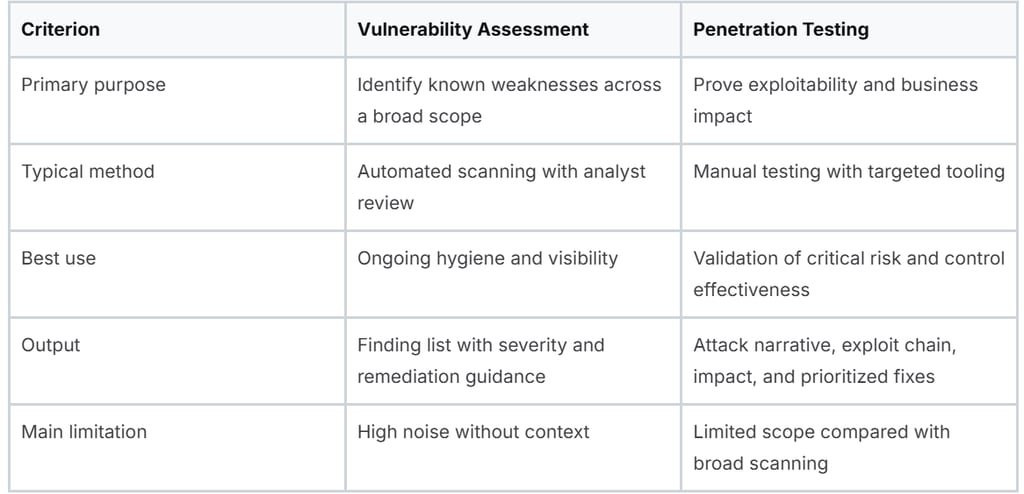
The easiest way to explain penetration testing and vulnerability assessment is this. One casts a wide net. The other picks a path and tries to break through.
A vulnerability assessment works like a security guard checking every door, window, and gate for obvious weaknesses. It's broad, fast, and systematic. It helps teams maintain coverage across a large environment, especially where assets change often.
A penetration test works like hiring a specialist to enter the property, avoid detection, move room to room, and see whether they can reach the safe. It's narrower in scope, deeper in execution, and centered on attacker behavior rather than checklist coverage.
The quick business distinction
A practical example makes this clearer. Say your scanner flags an outdated library in a customer portal and a misconfigured internal admin panel. The vulnerability assessment records both. A penetration test might show that the library isn't reachable in a meaningful way, while the admin panel can be chained with weak access controls to reach sensitive records. Same environment, very different priority.
That's why web applications need special attention. Web application penetration testing accounts for 35.60% of all tests, yet only 55% of organizations use third-party experts for at least half their web app surface, according to Bright Defense's penetration testing statistics roundup. Many teams still lean too heavily on automated scans for systems that attackers actively probe for logic flaws, insecure workflows, and chained weaknesses.
What works and what doesn't
What works: Continuous scanning for coverage, then focused manual testing on high-value applications, exposed services, identity boundaries, and change-heavy systems.
What doesn't: Treating scan severity as a direct proxy for business risk.
If your team can't explain which findings are exploitable in your environment, you don't have prioritization. You have inventory.
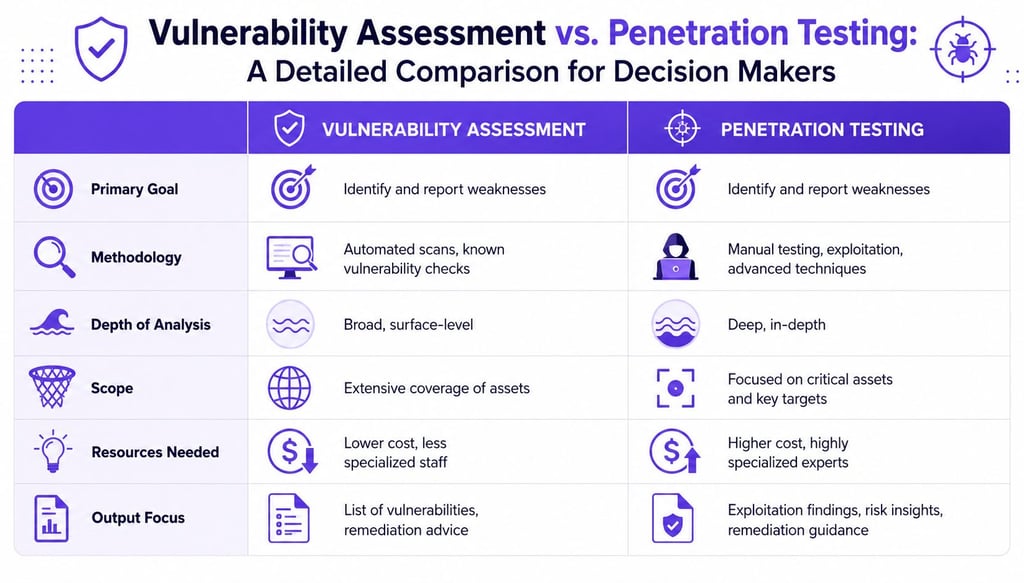
A Detailed Comparison for Decision Makers
Leaders don't need a textbook definition. They need a decision framework that explains cost, coverage, and risk reduction.
Identify critical assets first
List the applications, data stores, identity systems, cloud roles, and administrative workflows that would cause the most damage if compromised.
Separate coverage from proof
Keep vulnerability assessment for broad, recurring visibility. Use penetration testing to prove whether a path to impact exists.
Trigger tests when the business changes
Launches, migrations, integrations, and acquisitions should prompt targeted testing. Don't wait for the annual cycle.
Prioritize by exploitability, not score alone
Review whether findings can be reached, chained, and used against sensitive assets in your environment.
Map testing to compliance evidence
Make sure your scan records, remediation tickets, penetration test reports, and retest results support the controls your auditors will examine.
Measure whether fixes reduce risk
Track remediation speed, retest outcomes, and whether the original exploit path still works.
Security programs mature when leaders stop asking, “How many findings do we have?” and start asking, “Which paths to material impact still exist?”
Null Cipher Security helps organizations answer that question with adversary-simulated testing, executive advisory, and remediation verification. If you need a clearer view of what's exploitable across applications, networks, cloud environments, or human attack paths, talk with Null Cipher Security
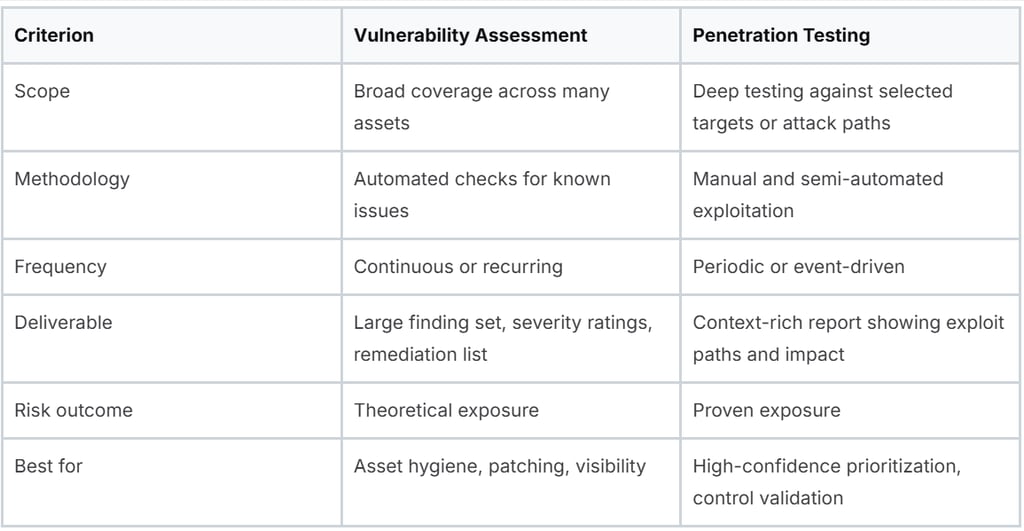
How each approach answers a different question
A vulnerability assessment answers, “What's wrong in the environment?” That matters because you can't patch what you haven't found. It supports routine discovery, patch cycles, and basic exposure management.
A penetration test answers, “What can an attacker achieve?” That answer usually carries more weight with executives because it maps technical findings to business consequences. Can a tester pivot from a low-privilege web user to an internal admin panel? Can they exploit injection to reach regulated records? Can they abuse a cloud role to access build artifacts or secrets?
Practical rule: Use vulnerability assessment to manage scale. Use penetration testing to manage consequence.
Take a common application case. A scanner identifies an injection issue and assigns high severity. That's useful, but incomplete. An experienced tester checks whether the input reaches a real interpreter, whether parameterized queries are in place, whether output handling is broken, and whether exploitation leads anywhere meaningful. OWASP's current guidance for A05 Injection requires parameterized queries, input validation and sanitization, and context-specific output escaping, as outlined in SentinelOne's OWASP Top 10 reference.
Why CVSS alone creates bad priorities
The biggest failure I see in security programs is over-trusting severity scores. A high score may reflect technical seriousness in the abstract. It doesn't automatically reflect exploitability in your environment.
A 2025 Gartner report found that 68% of enterprises still remediate based solely on CVSS scores, which leads to wasted effort. The same analysis noted that integrating exploitability data, a key outcome of penetration testing, can reduce false-positive remediation efforts by 42%, according to SentinelOne's analysis of vulnerability testing versus penetration testing.
That gap shows up in simple situations:
Medium severity, high business impact: A modest access control flaw in an admin workflow might let an attacker approve refunds, view customer records, or change privileged settings.
Critical severity, low practical value: A severe issue in an isolated component may be unreachable, segmented, or blocked by compensating controls.
Chained risk: Three low-signal issues together may create a credible path to domain privileges or data exfiltration.
Attackers don't remediate by score. They exploit by path.
For decision makers, the takeaway is straightforward. Don't fund programs that only produce severity labels. Fund programs that tell you which findings create credible attack chains, which assets matter most, and which fixes break those chains.
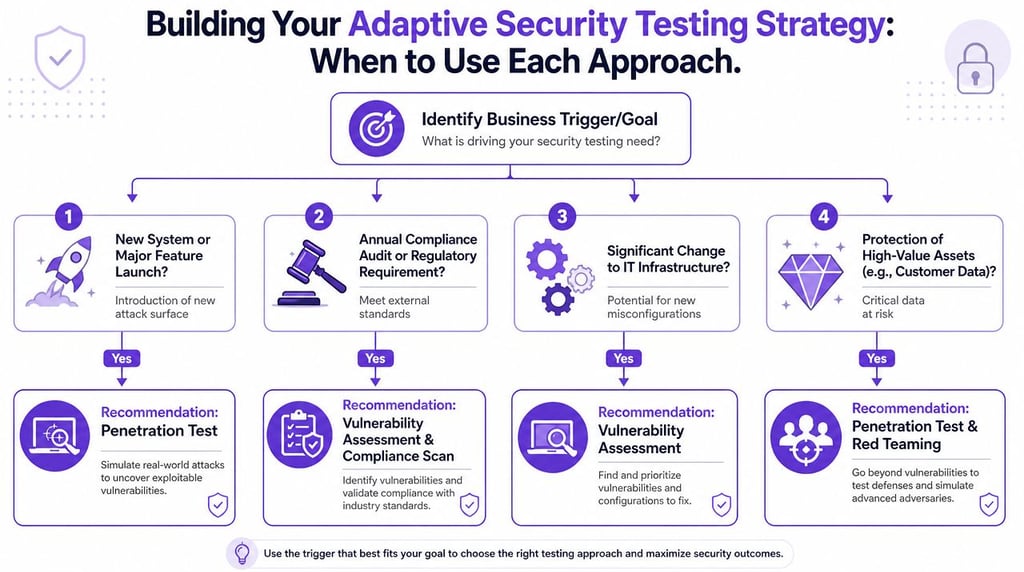
Building Your Testing Strategy When to Use Each Approach
Rigid annual testing schedules look clean in a policy document. They don't reflect how environments change. New code ships. Cloud roles expand. Vendors connect to internal systems. Migrations create blind spots. Risk moves faster than the calendar.

The better model is adaptive. Keep vulnerability assessment running as an operational control. Trigger penetration testing when business change creates a meaningful attack opportunity.
Use vulnerability assessment for operational hygiene
Run vulnerability assessments continuously across infrastructure, endpoints, cloud assets, external exposure, and application components. In practical terms, that means using your scanner output to support patching, detect drift, and flag common weaknesses before they accumulate.
Use it when:
Teams release often: CI/CD introduces change faster than manual reviews can keep up.
Cloud assets shift daily: New services, roles, and configurations appear constantly.
You need baseline visibility: Asset discovery and known-vulnerability coverage still matter.
Scanners prove their worth. They scale. They repeat. They give operations teams a working backlog.
A useful reference point for tool validation is the OWASP Benchmark framework overview from Kiuwan, which explains how automated tools are measured with precision, recall, true positive rate, and outcomes such as true positives and false positives. That framework is a reminder that detection accuracy matters, especially when your teams already have more tickets than they can close.
Here's a practical explainer before the decision points:
Use penetration testing when change creates exposure
Penetration testing should follow business triggers, not just compliance anniversaries.
Use it before or after events like these:
Major product launch
A new customer portal, mobile app, API release, or admin workflow creates fresh attack surface. Test the parts attackers will target first.
Cloud migration or architecture change
New trust boundaries, IAM assumptions, storage paths, and segmentation rules often introduce exploitable gaps.
Third-party integration or M&A activity
External connections and inherited environments can undermine controls you thought were stable.
Protection of high-value assets
If a system touches regulated data, payment flows, privileged workflows, or core intellectual property, prove whether compromise is possible.
A 2026 report found that organizations using trigger-based penetration testing tied to major changes experienced 3.2x fewer breaches than organizations relying on fixed annual tests, according to Cymulate's analysis of vulnerability assessment versus penetration testing cadence. That's the clearest argument against a calendar-only model.
If you're shaping a broader offensive security program, security testing services should support this adaptive cycle rather than force every engagement into the same annual box.
Aligning Testing with Compliance Mandates
Compliance frameworks don't treat scans and penetration tests as interchangeable evidence. Auditors usually want to see both: routine identification of weaknesses and validation that controls hold up under realistic attack conditions.
Where scans fit
Vulnerability assessments support the operational side of compliance. They help demonstrate that you identify known weaknesses, monitor systems, and maintain a repeatable remediation process.
That matters in frameworks such as SOC 2, ISO 27001, and HIPAA because auditors typically look for evidence that security controls aren't static. They want to see ongoing review, issue tracking, and follow-through. A current scan program helps prove that your team looks for exposed services, missing patches, outdated components, and configuration drift on a regular basis.
A practical example: if your engineering team pushes changes to an internet-facing application every sprint, recurring vulnerability assessment supports the case that you aren't waiting for an annual review to identify common issues.
Where penetration tests matter
Penetration testing provides a different class of evidence. It validates whether controls resist exploitation in a realistic scenario.
That distinction is especially important when auditors ask whether your controls are merely documented or actually effective. A penetration test can show whether segmentation prevents lateral movement, whether MFA controls can be bypassed through workflow flaws, whether an exposed application allows privilege escalation, or whether sensitive data remains protected after an initial foothold.
This matters even more as application risk evolves. The 2025 OWASP Top 10 introduced A03 Software Supply Chain Failures as a new critical category, expanding concern beyond outdated components to dependencies, build systems, and package repositories. It also raises the need for SBOM generation and package integrity verification, as described in Outpost24's review of the 2025 OWASP Top 10 changes. A scan may tell you a component is outdated. A penetration test can show whether a supply chain weakness opens a path to compromise in your delivery pipeline or production environment.
Compliance teams accept evidence. Attackers test reality. Your program has to satisfy both.
For CISOs, the practical move is to map each control objective to the testing evidence that best supports it. Automated assessment shows continuous oversight. Penetration testing shows control effectiveness under pressure. If your organization needs that mapping tied to advisory work, security and compliance solutions reflect the kind of integrated support many teams need before an audit cycle.
From Report to Remediation The Verification Loop
Most testing programs fail after the report. Findings enter a ticket queue, ownership gets fuzzy, deadlines slip, and leadership sees the same issue again in the next engagement. That isn't remediation. It's administrative recycling.
The fix is a closed loop: triage, assign, remediate, retest, and measure. Without verification, you're trusting that a code change, config update, or cloud policy edit removed the attack path.
Prioritize by exploit path and business effect
Start by sorting findings into what an attacker can use now, what requires chaining, and what remains mostly theoretical. Don't rank issues by severity label alone. Rank them by exposure, access gained, and business consequence.
For example:
Immediate action: Broken access control in a customer-facing app that exposes account data.
Near-term action: Weak internal segmentation that only becomes dangerous after an initial foothold.
Planned action: Low-value informational findings that don't materially change attack options.
Good reports are critical. The best ones show proof-of-concept exploitability, affected assets, prerequisite conditions, and practical remediation steps. They also identify the owner. Application issues belong with engineering. IAM weaknesses belong with cloud or identity teams. Detection gaps may belong with security operations.
If a finding doesn't have an owner, a due date, and a retest plan, it's not on a remediation path.
Verify fixes instead of trusting tickets
Retesting closes the loop. If developers replace string-built queries with parameterized queries, retest the affected workflow. If cloud engineers narrow permissions, retest the privilege path. If the issue was chained, verify that the chain is broken, not just one step.
Leadership should track this work in business terms. Key penetration testing metrics for leadership include Mean Time to Remediate (MTTR) against SLAs and Financial Risk Reduction, as outlined in Indusface's guide to penetration testing metrics. Those measures help translate security activity into operational efficiency and loss avoidance.
A simple executive review should answer four questions:
Which findings created credible business risk
Who owns each fix
When verification will occur
Whether the retest confirmed risk reduction
That last step matters most. Closed findings on a dashboard don't protect the organization. Verified fixes do.
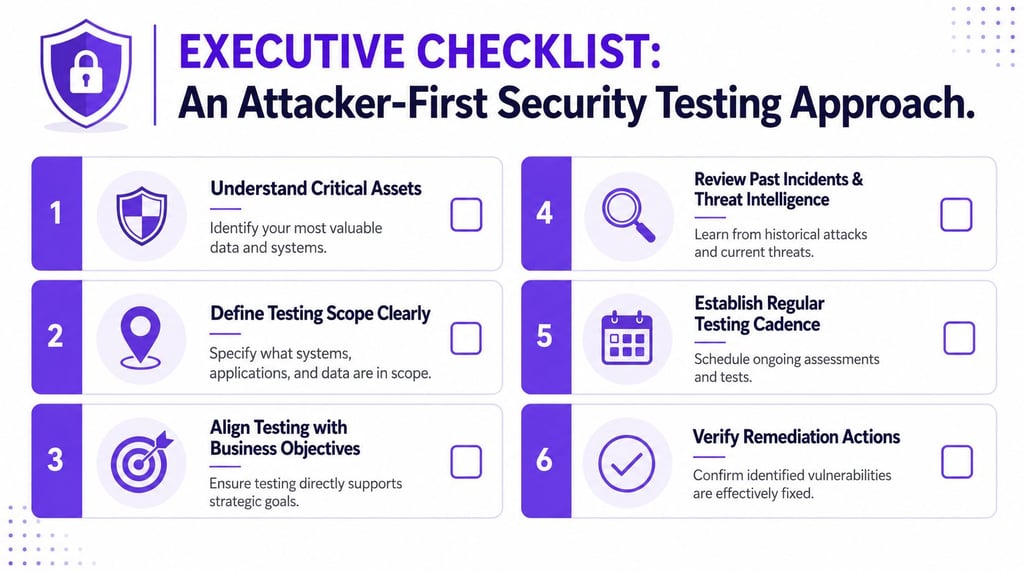
An Attacker-First Security Testing Checklist
Security leaders don't need a bigger backlog. They need a sharper decision model. Use this checklist to pressure-test your current program.