
Cybersecurity for Startups: A Founder's Playbook
A practical cybersecurity for startups playbook. Learn how to prioritize threats, budget for security, and build a roadmap for SOC 2, ISO, and HIPAA readiness.
Cybersecurity for Startups: A Founder's Playbook
A practical cybersecurity for startups playbook. Learn how to prioritize threats, budget for security, and build a roadmap for SOC 2, ISO, and HIPAA readiness.
Null Cipher Security
7/4/202610 min read
A founder at seed or Series A usually faces the same sequence. The team launches on AWS, GCP, or Azure. They wire up GitHub, Slack, Google Workspace, Notion, Linear, HubSpot, and a handful of SaaS tools through convenience-first admin settings. Then a customer asks who has production access, how secrets are stored, and what happens if an engineer laptop gets stolen.
Most startups answer too late and too loosely.
Security work matters most when it protects revenue and reduces obvious exposure. A good startup program does three things well. It hardens your most exposed systems, gives you enough evidence to satisfy customer reviews, and creates a repeatable operating model so security doesn't depend on one careful engineer remembering everything.
The founder trade-off
Early teams usually make one of two mistakes:
They underbuild. Everyone is an admin, shared accounts exist, and production changes happen with almost no guardrails.
They overbuild. They buy too many tools, write heavyweight policies, and distract engineering with controls they can't maintain.
The right answer sits in the middle. Use simple controls first. Lock down identity. Reduce public exposure. Store logs and backups outside the blast radius. Test what you ship.
Practical rule: If a customer can ask about it on a security questionnaire, you should be able to point to an owner, a control, and evidence.
A buyer rarely expects a seed-stage startup to look like a bank. They do expect signs of competence. If you can show enforced MFA, controlled production access, centralized logs, and a credible incident process, you already look more mature than many peers.
Your Security Roadmap by Funding Stage
Founders often ask the wrong budgeting question. They ask, “How much security do we need?” The useful question is, “What level of security does our current stage and exposure demand right now?”
That's how you close the budget-to-risk translation gap. Spend should follow attack surface, customer expectations, and operational complexity. Don't fund a full enterprise security stack at seed. Don't delay core testing and governance when Series A customers start asking for proof.
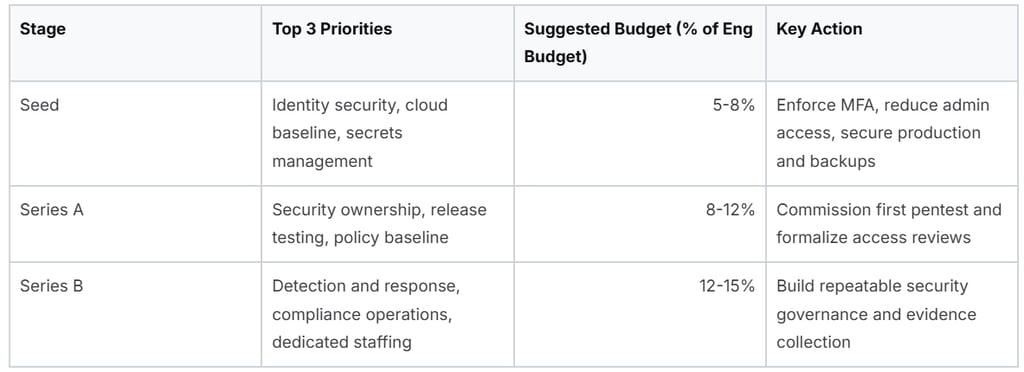
Seed stage priorities
At seed, security failures usually start with identity, cloud basics, and uncontrolled access. Fix those first.
Your top priorities:
Lock founder and admin accounts. Enforce MFA on email, cloud, code repositories, finance, and identity providers. Remove shared logins.
Harden the cloud baseline. Limit public exposure, restrict broad permissions, and separate development from production.
Control secrets and access. Move credentials out of chat, tickets, and code. Use a managed secrets store and a clear joiner-mover-leaver process.
If you're building on AWS, a focused AWS cloud security action plan for startup leaders helps founders identify what must be configured early versus what can wait.
Series A priorities
Series A changes the problem. You now have more people, more code, more customers, and more reasons for buyers to inspect your controls.
The next moves:
Formalize security ownership. Assign a leader, even if that's a fractional owner, and stop treating security as side work.
Introduce release-based security checks. Review internet-facing changes, APIs, authentication flows, and privilege paths before major launches.
Run your first serious external test. A penetration test becomes useful when the product is stable enough to assess and important enough to defend.
A startup doesn't need every control at once. It needs the controls that stop one mistake from becoming a company-wide incident.
Series B priorities
By Series B, your environment usually contains multiple products, growing vendor sprawl, and stronger compliance pressure. The challenge isn't only prevention. It's consistency.
Focus on:
A dedicated security function. Someone must own roadmap, exceptions, risk decisions, and audit evidence.
Detection and response maturity. Logging, alerting, escalation, and tabletop exercises can't stay informal.
Compliance as an operating system. SOC 2, ISO 27001, or HIPAA readiness needs real control ownership across engineering, IT, HR, and leadership.
These budget ranges are practical rules of thumb, not universal formulas. A fintech startup with sensitive data will spend differently than a lightweight B2B workflow tool. The point is to tie spend to exposure and customer demand, not gut feel.
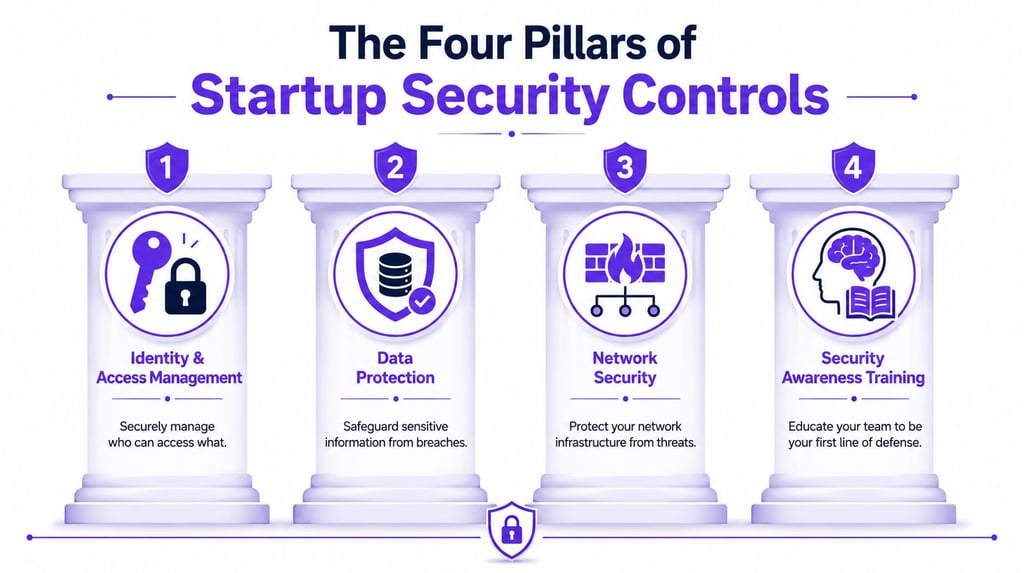
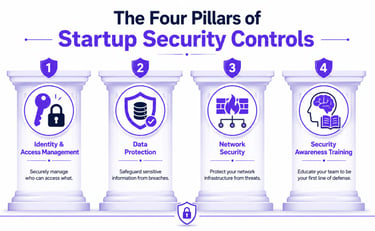
The Four Pillars of Startup Security Controls
Most startup environments don't get compromised through movie-plot attacks. They get compromised through weak identity, exposed services, poor cloud permissions, insecure code, and bad recovery planning. Software vulnerabilities now account for 31% of all breaches as the initial access route, surpassing stolen passwords, which is why application and exposure management can't wait until “later” (software vulnerabilities as the leading initial access route).
Identity and access management
Start here because identity failures spread fast.
Use an identity provider such as Okta or Microsoft Entra ID. Enforce MFA on critical accounts. Remove standing admin where you can. Give engineers role-based access instead of broad permissions that never get reviewed.
For example, a seed team often lets every engineer touch production because it saves time. That works until a compromised laptop or stolen session token gives an attacker the same reach. Tighten privileged access first. It's faster than rebuilding trust after an incident.
Protect control planes: Email, cloud consoles, GitHub, CI/CD, and admin panels need the strongest authentication.
Kill shared access: Shared credentials destroy accountability and slow investigations.
Review leavers fast: Disable accounts the same day someone exits or changes role.
Cloud and network security
A flat environment gives attackers room to move. Don't build one.
Production should be isolated from development. Internal services should talk selectively, not universally. VPN, SSO, and segmentation decisions matter because they limit lateral movement when one system gets compromised. Backups and centralized logs should live outside the main environment, ideally on a different provider, so you still have recovery options if your primary cloud tenant gets hit.
A lot of startups learn this the hard way after putting logs, backups, and workloads in the same blast radius. When that happens, recovery becomes guesswork instead of a process.
Application and data security
Many founders underinvest because product pressure is relentless. Don't rely on code review alone.
Build these into engineering:
Secure secrets handling: Use a secrets manager. Keep credentials out of repositories and tickets.
Release-based testing: Review authentication, authorization, file upload, API exposure, and tenant isolation before major releases.
Data minimization: Don't keep sensitive data you don't need. Every retained field increases your problem set.
An external penetration testing and vulnerability assessment program helps validate whether your real controls hold up under attacker behavior, not just internal assumptions.
Operations and endpoint security
Your laptops, SaaS tools, and daily processes matter more than founders want to admit. One unmanaged endpoint or one stale admin account can bypass all the elegant security architecture behind it.
Use managed devices. Require disk encryption, screen lock, and endpoint protection. Keep an asset list. If you don't know which laptops, SaaS apps, and cloud roles exist, you can't secure them.
The fastest way to improve cybersecurity for startups is to reduce uncertainty. Know who has access, what's exposed, where data lives, and how you recover.
Building Your Detection and Response Flywheel
Prevention reduces odds. Detection reduces damage.
A lot of startups treat monitoring as something only mature security teams do. That's a mistake. If you can't see account abuse, unusual admin actions, suspicious authentication events, or failed access patterns, you won't know a problem exists until a customer reports it.
Start with visibility
You don't need a huge SOC to get value. You need centralization and basic triage.
Push logs from your identity provider, cloud platform, code repository, endpoint tooling, and critical SaaS apps into one place. That might be a SIEM, a cloud-native logging platform, or a managed service. What matters is that your team can answer simple questions quickly: who logged in, what changed, what was accessed, and what failed.
Useful first alerts include:
Privileged login activity: New admin sessions, impossible travel signals, or unusual login patterns
Security control changes: MFA disabled, audit logging turned off, permission boundaries loosened
Production risk events: New public exposure, secrets misuse, unusual data access, or deployment anomalies
Remote admin paths deserve special attention because they're a common bridge into more sensitive systems. A focused review of remote access security controls and attacker pathways helps teams tighten that entry point.
Keep response simple
Your first incident response plan should fit on one page. Longer doesn't mean better.
Write down:
Who declares an incident
Who joins the call
Who can disable accounts or isolate systems
How you preserve evidence
Who speaks to customers, legal counsel, and leadership
Then test it on a realistic scenario. For example, run a tabletop for a compromised Google Workspace admin, a leaked GitHub token, or suspicious access to a production database. If the team argues about ownership for half the meeting, that exercise already paid off.
A startup's response process fails for one reason more than any other. Nobody knows who has authority to act in the first hour.
The flywheel effect is simple. Logging improves visibility. Visibility improves investigations. Investigations improve playbooks. Better playbooks improve future detection. Start small, but start.
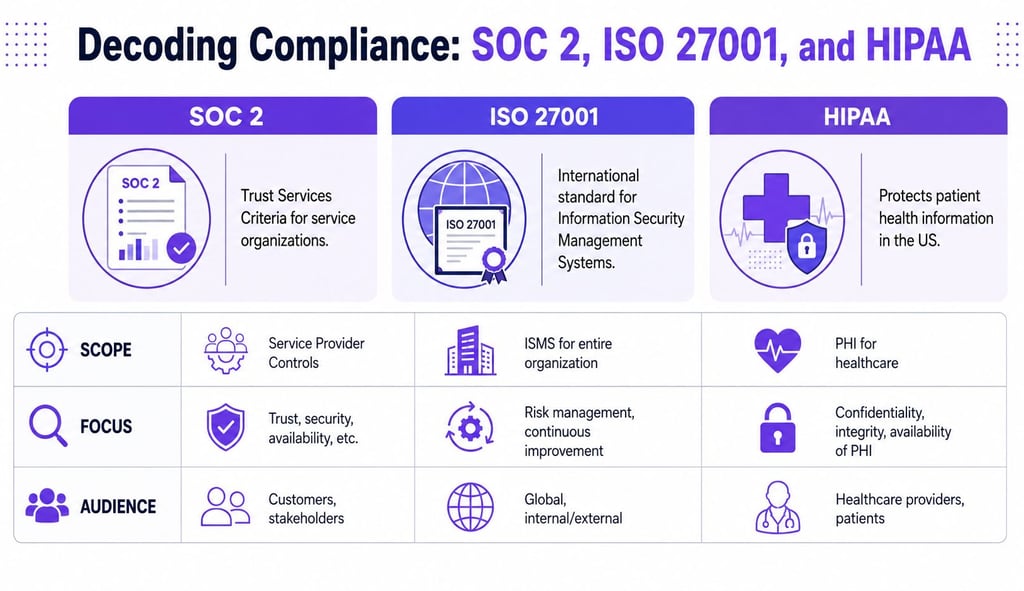
Decoding Compliance SOC 2 ISO 27001 and HIPAA
Compliance language confuses founders because the labels sound bigger than the work underneath them. In practice, these frameworks mostly ask whether your company runs security in a controlled, repeatable way.
That's why startups should stop treating compliance as a separate project. If you've already built sensible identity controls, change management, logging, backups, vendor reviews, and incident handling, you've already built a large part of what audits look for.


What each framework means in practice
SOC 2 usually matters when you sell software or services to business customers that want assurance over security controls. Buyers often ask for it because procurement teams need a common benchmark.
ISO 27001 is a management-system standard. It pushes your company to define scope, assess risk, assign ownership, and improve controls through a formal operating model. It often fits companies selling internationally or dealing with structured enterprise procurement.
HIPAA matters when your product creates, stores, transmits, or supports protected health information in the United States. It changes how you handle access, auditability, vendors, and operational safeguards.
A founder doesn't need to memorize framework language. They need to know which one customers expect and whether the current control set can produce evidence.
How controls become audit evidence
Auditors don't just ask if you “care about security.” They ask for proof.
Examples of useful evidence include:
Access evidence: MFA settings, user lists, role reviews, termination records
Operational evidence: Ticketed changes, incident records, vulnerability remediation tracking
Governance evidence: Policies, risk assessments, vendor reviews, training acknowledgments
Here's the practical shortcut. If engineering uses GitHub pull requests, cloud IAM roles, ticketed changes in Jira, device controls in MDM, and centralized logs, those systems can become evidence sources. The less your team relies on screenshots and memory, the smoother the audit goes.
Compliance goes badly when a startup writes policies first and builds controls later. Build the control, assign the owner, then document how it works.
Budgeting and Building Your Security Team
Most founders know security matters. They still underfund it because they can't translate risk into a spending plan. Recent 2025 data from CRN shows that 68% of startups underfund security due to unclear prioritization metrics, which is the clearest expression of the budget-to-risk translation gap founders deal with (startup security underfunding and the budget-to-risk gap).
The fix is simple. Don't budget for “security” as a vague bucket. Budget for outcomes.
What to budget at each stage
At seed, spend on controls that remove obvious single points of failure. That usually means identity hardening, device management, centralized logging, backup separation, and targeted advisory help to avoid bad architectural decisions.
At Series A, budget starts shifting toward program structure. You need someone to own policy baselines, vendor reviews, access governance, release testing, and customer questionnaire support. This is also when an external penetration test starts making sense if the product and attack surface are stable enough to evaluate.
At Series B, spend broadens again. You may need a dedicated security engineer, regular external testing, stronger monitoring, audit preparation, and a roadmap that coordinates engineering, IT, legal, and leadership.
A practical budgeting split often looks like this:
Foundational controls first: Identity, endpoint, logging, backup, and cloud posture work before niche tooling
Validation second: External testing, configuration reviews, and remediation support
Scale third: Compliance automation, broader monitoring, and additional headcount
When to hire and when to outsource
A full-time security hire is rarely the first answer at seed. Most startups benefit more from a fractional vCISO or senior advisor who can set priorities, review architecture, support customer diligence, and keep engineering focused on the highest-value fixes.
Hire a full-time security engineer when the company has enough complexity to justify continuous internal ownership. Common signs include multiple production environments, a meaningful compliance load, frequent enterprise security reviews, or enough engineering activity that security issues keep resurfacing between outside engagements.
Bring in outside experts when you need specialist depth, independent validation, or attacker perspective. That includes:
Before major enterprise sales motions: To avoid getting blocked on basic diligence
Before compliance audits: To verify controls work in practice
After major architecture changes: To test whether new APIs, apps, or cloud patterns created exploitable paths
The bad version of startup security spending is random tool buying. The good version is stage-based investment tied to systems, people, and proof.
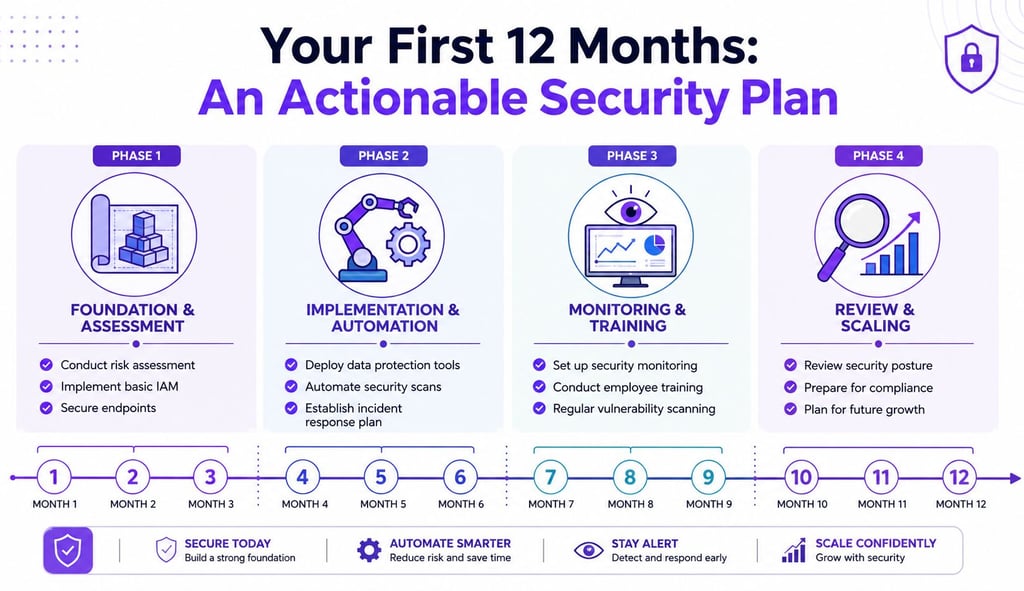
Your First 12 Months An Actionable Security Plan
You don't need a perfect program in year one. You need a disciplined one that keeps pace with growth.
Start with this roadmap.

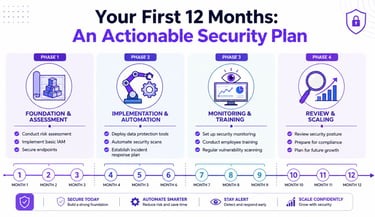
Quarter by quarter priorities
Months 1 to 3
Lock down identity and admin access. Enforce MFA on critical systems. Inventory laptops, SaaS apps, cloud accounts, and repositories. Turn on centralized logging for identity, cloud, and code platforms. Separate backups and confirm you can restore.
Months 4 to 6
Review cloud configuration, public exposure, and privilege paths. Move secrets into managed storage. Tighten endpoint controls. Write the one-page incident response plan and run one tabletop exercise.
This video gives a useful executive-level view of how to approach the first steps:
Months 7 to 9
Run external testing against your highest-risk internet-facing systems. Fix material findings. Formalize access reviews, onboarding, offboarding, and change approval for sensitive systems.
Months 10 to 12
Choose the compliance path your buyers care about. Gather evidence from the systems you already use. Identify whether you need ongoing vCISO support, a dedicated hire, or both.
If you do those steps well, cybersecurity for startups stops being a recurring fire drill. It becomes an operating advantage.