
Compliance Gap Analysis: A CISO's Practical Guide
Learn to conduct a compliance gap analysis that goes beyond checklists. Our CISO guide covers scoping, risk-based prioritization, and remediation.
Compliance Gap Analysis: A CISO's Practical Guide
Learn to conduct a compliance gap analysis that goes beyond checklists. Our CISO guide covers scoping, risk-based prioritization, and remediation.
Null Cipher Security
7/4/202610 min read
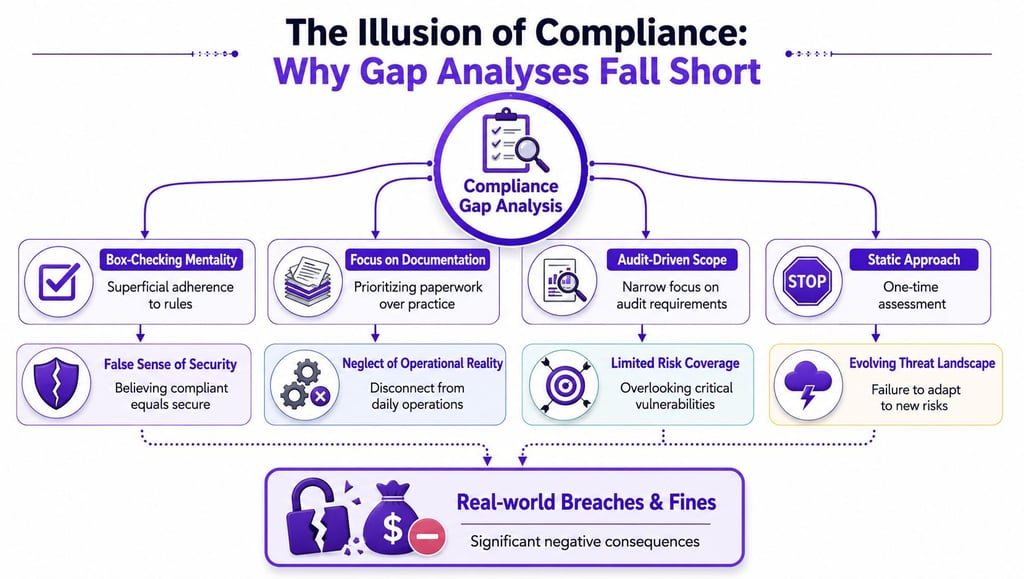
The standard playbook says to collect policies, line them up against a framework, and mark each requirement as present or missing. That's tidy. It's also why many programs miss the underlying issue.
Most existing content treats compliance gap analysis as a static checklist for control existence, ignoring the critical gap between documented controls and actual operational effectiveness. Data shows that 73% of organizations fail compliance audits due to control drift, where policies exist but aren't followed in practice (Compliance.com on control drift and effectiveness evaluations).
The paper control problem
A documented control answers one question. Did someone write down the rule?
An operational control answers the question that matters. Does the rule hold when a real person uses the system, changes a role, deploys code, approves access, or responds to an incident?
That gap shows up everywhere:
Access management: The policy requires least privilege, but the identity platform still has old groups with broad rights.
Change control: The procedure requires approvals, but hotfixes move through a side channel in Slack or GitHub without review.
Logging: The standard requires audit trails, but retention is inconsistent and critical logs never reach the SIEM.
Vendor oversight: The contract requires security review, but no one can produce evidence that reviews happened.
Practical rule: If a control can't survive a walkthrough, log review, and a targeted technical test, treat it as unproven.
What attackers test first
Attackers don't care whether your spreadsheet shows green. They test whether enforcement breaks at the edges.
In practice, that means they look for the places where policy and operations diverge. They check stale accounts after offboarding. They look for cloud roles that were granted during an incident and never removed. They trace CI/CD permissions that let one compromised token reach production. They exploit the exception process because exceptions often have no expiry and little oversight.
A useful compliance gap analysis adopts that same lens. It asks:
Where does the control live
Who operates it
What evidence proves it worked
How would someone bypass it
This is the mindset shift most programs need. Audit readiness matters. Security reality matters more.
Defining Your Battlefield Scoping and Control Mapping
A strong compliance gap analysis starts with scope discipline. If scope is vague, findings become vague, and remediation turns into a budget fight.
A compliance gap analysis is a systematic process that evaluates an organization's current policies, procedures, and practices against specific regulatory standards or frameworks such as SOC 2, ISO 27001, CMMC, HIPAA, Dodd-Frank, and Basel III to identify areas of non-compliance (Secureframe's definition of compliance gap analysis).
Start with the obligation, not the template
Don't begin with a generic questionnaire. Start with the business obligation that created the need for review.
For most organizations, that obligation falls into one of these buckets:
Customer driven: Enterprise deals require SOC 2 or ISO 27001 alignment.
Regulatory: Healthcare, financial, defense, or multinational operations introduce specific legal requirements.
Board and risk driven: Leadership wants proof that critical controls work across cloud, identity, and software delivery.
Then narrow the field:
Choose the framework: SOC 2 for customer assurance, ISO 27001 for broader ISMS maturity, HIPAA for regulated health data, CMMC for defense supply chains.
Define the in-scope business units: Finance, engineering, support, HR, and third-party managed functions don't carry equal weight.
Pinpoint the systems: AWS accounts, Azure subscriptions, GCP projects, Okta or Entra ID tenants, GitHub organizations, Jira, endpoint tools, SIEM, ticketing platforms, and key SaaS platforms.
State the boundary: Production only, or production plus staging, CI/CD, and developer endpoints.
For cloud-heavy teams, scoping usually breaks first at the shared services layer. Identity, secrets management, build pipelines, and logging platforms affect multiple frameworks and multiple business processes. That's where mapping effort pays off. For a practical cloud governance reference, see this AWS action plan for CISOs.
Map controls to systems people and evidence
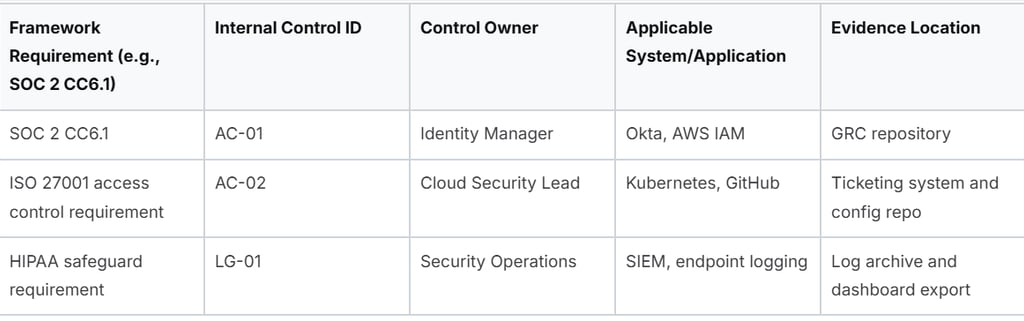
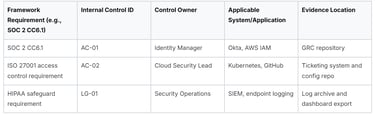
A control isn't real until you know four things. The requirement, the owner, the system where it operates, and the evidence that proves execution.
Use a simple matrix and force precision early.
That table looks basic. It prevents a common failure. Teams often map requirements to policy names, not to operating systems and accountable people.
A control owner who can't point to the exact system and exact evidence location doesn't own an operating control. They own a statement.
A scoping workshop should end with visible decisions, not abstract agreement. If an application stores regulated data, name it. If a cloud account is out of scope, document why. If a business unit relies on a third party, capture the dependency now instead of discovering it during evidence collection.
From Theory to Reality Evidence Collection and Identification
The common pitfall for most weak assessments is this: Teams ask for documents. They should ask for proof.
A rigorous approach follows six steps: define scope including specific regulations and business functions; decompose regulatory requirements into testable obligations; assess current controls, policies, and documentation against those obligations; identify and classify gaps by severity; prioritize gaps based on risk exposure and remediation effort; and assign ownership with target closure dates (MetricStream's six-step methodology).
Turn requirements into testable checks
Take a requirement like “access to production systems is restricted.” That's too broad to assess directly. Break it into checks that a reviewer, engineer, and tester can all evaluate.
For example:
Identity layer: Review SSO group assignments, privileged roles, break-glass accounts, and MFA enforcement.
Cloud layer: Pull AWS IAM roles and permission boundaries. Review who can assume privileged roles and under what conditions.
Container layer: Inspect Kubernetes RBAC roles, role bindings, service accounts, and namespace separation.
Activity layer: Check session logs, approval records, and change tickets to see whether access was used as intended.
Revocation layer: Verify offboarding and access review workflows removed rights on time.
This is also the point where a security team should use offensive validation, not just administrative review. A targeted penetration testing and vulnerability assessment program helps confirm whether an attacker can chain “minor” control gaps into material access.
A cloud native example
Consider a SaaS company running a customer-facing application on Kubernetes in AWS. The written policy says only authorized engineers can access production, changes require approval, and all privileged activity is logged.
A weak review would collect the access control policy, a screenshot from the identity provider, and a manager attestation.
A useful review would go further.
What to collect
AWS IAM artifacts: Role definitions, trust policies, permission boundaries, and role assignment records for production-related accounts.
Kubernetes artifacts: ClusterRole and RoleBinding configuration, service account permissions, namespace restrictions, and admission control settings.
Pipeline artifacts: GitHub branch protection settings, deployment workflow permissions, and approval gates in the CI/CD platform.
Logging artifacts: Cloud audit trail records, cluster audit logs, privileged session evidence, and log retention settings.
Process artifacts: Joiner-mover-leaver tickets, periodic access review records, incident exception approvals, and change management approvals.
What to test
A consultant with an attacker's mindset doesn't stop at review. They try to disprove the control.
They ask whether a developer in a non-production group can still inherit production access through an old IAM role. They check whether a service account in one namespace can reach cluster-wide resources. They compare the change ticket against deployment timestamps to see whether approvals happened before the change or after the fact. They test whether logs capture the exact action needed for reconstruction.
If the evidence shows the policy exists but the path to bypass it still works, the control failed.
Evidence that holds up
Good evidence has three qualities. It is current, system-derived, and traceable to the requirement.
Use this standard when reviewing artifacts:
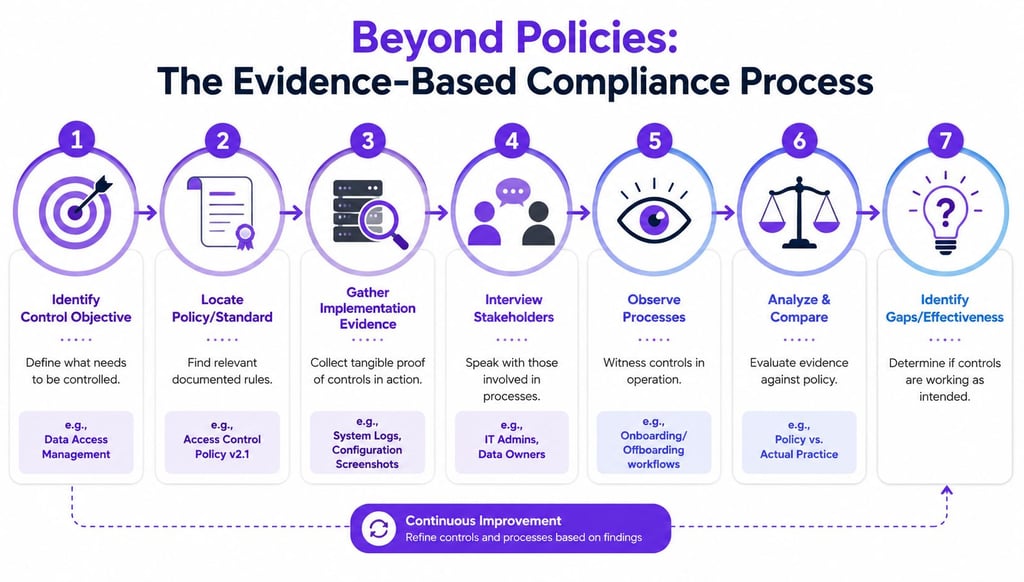
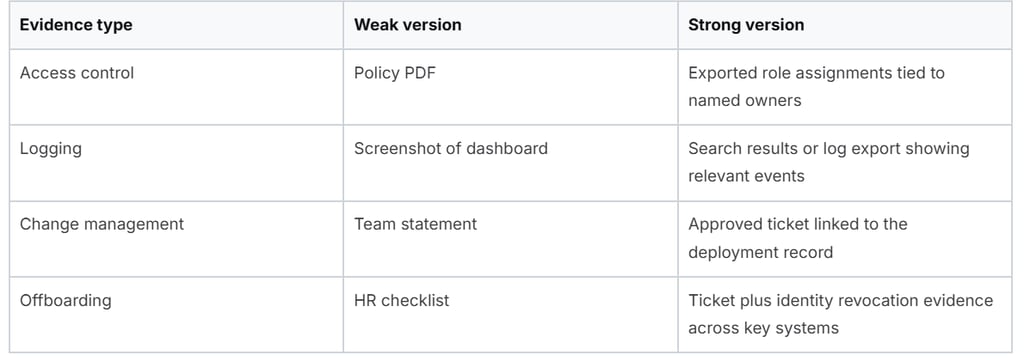
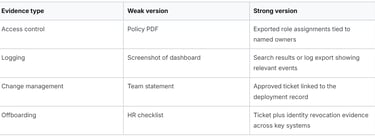
Interviews matter too, but only when they test consistency between claimed process and observed process. Ask operators to walk through a real recent example. Ask them to show the ticket, the approval, the config, and the log.
Three patterns usually signal a real gap:
Control exists only in narrative form
Evidence exists, but it's stale or incomplete
Technical enforcement and process enforcement contradict each other
When that happens, classify the issue against the failure mode. Missing control. Weak control. Evidence gap. Or control drift between design and execution.
Prioritizing the Fixes That Matter Most
A list of findings isn't a strategy. It becomes useful only when leadership can decide what to fund, what to fix now, and what to accept temporarily.
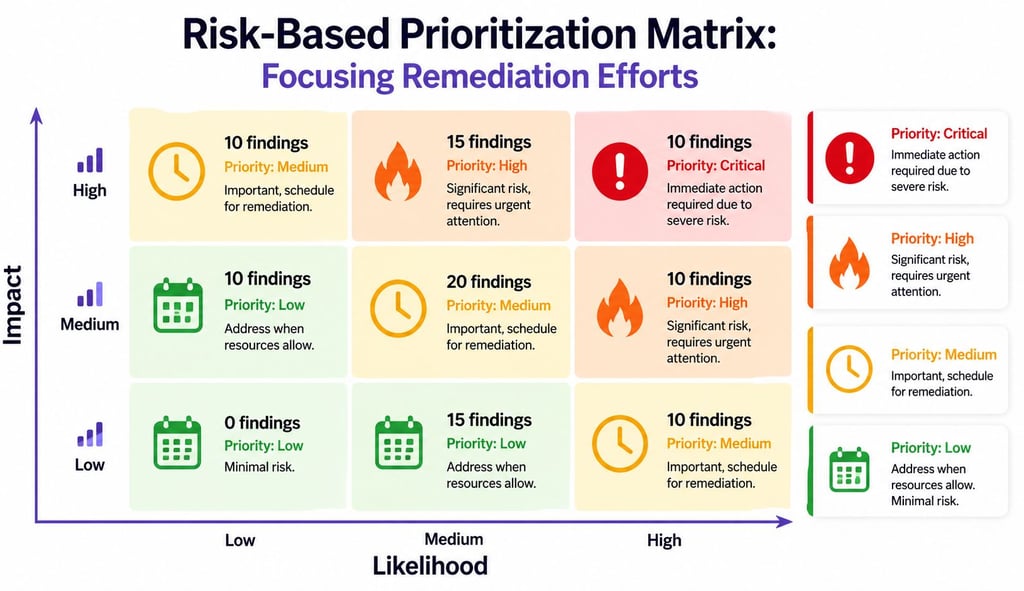
Effective gap analysis prioritizes gaps based on risk severity and potential impact, explicitly considering factors such as financial penalties, reputational damage, and operational disruptions to determine which critical actions to address first (Bryter on risk-based prioritization).

Rank gaps by business impact
Teams often prioritize by audit language alone. That creates noise.
A missing approval record for a low-risk internal process might still matter. But it shouldn't outrank broad production access, weak privileged session logging, or an exception that leaves sensitive data exposed.
Use business impact questions that executives understand:
Financial exposure: Could this gap contribute to penalties, failed deals, fraud, or costly response work?
Operational disruption: Could this gap stop releases, interrupt service, or delay recovery?
Reputational harm: Would customers, regulators, or the board view this as a breakdown in basic control hygiene?
Exploitability: Can an attacker or insider reasonably abuse the weakness with available access?
A simple decision model
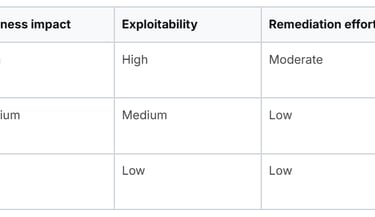
Plot each finding on two axes. Impact and remediation effort.
This keeps the roadmap honest. Some findings sound severe but require platform redesign. Others look minor in an audit worksheet and can be fixed quickly with massive risk reduction.
A practical model looks like this:
Fix now: High impact, low to moderate effort. Example: broad standing admin access in production that can be converted to approved, time-bound elevation.
Plan this quarter: High impact, high effort. Example: fragmented logging architecture that needs consolidation before evidence becomes reliable.
Schedule deliberately: Lower impact, low effort. Example: inconsistent naming or documentation that affects audit friction more than attack path.
Accept temporarily with controls: Lower impact, high effort. Example: legacy edge cases awaiting application retirement, with compensating oversight in place.
Board-level translation: "We reduced broad production access and improved traceability of privileged actions" lands better than "we closed seven medium findings."
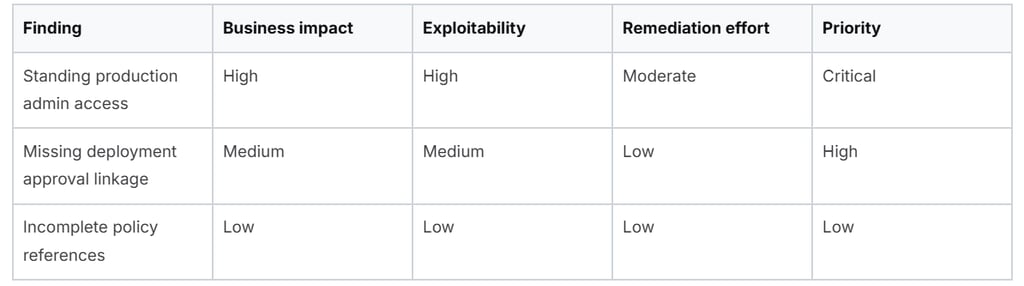
A short prioritization record helps avoid debate fatigue:
What doesn't work is scoring every issue through a complex formula that no one trusts. Keep the rationale visible. If leadership can see why a finding matters in operational and business terms, they'll support the fix.
Creating a Credible Remediation Roadmap
Remediation plans fail when they're written for auditors instead of operators. A credible roadmap tells engineering, security, and leadership exactly what changes, who owns it, and how success will be verified.


What a defensible plan includes
Strong roadmaps have a few essential elements:
Named owner: One person, not a department.
Target date: A realistic closure date, not “Q3” or “pending.”
Remediation action: The technical or procedural change required.
Dependency note: Platform team input, vendor change, code release, procurement, or policy approval.
Verification criteria: The evidence needed to mark the item complete.
For multinational or more complex organizations, the action plan also needs clear tasks, timelines, responsible parties, and resource requirements. That structure is a core part of formal compliance gap analysis practice, especially when multiple stakeholders and locations are in scope, as outlined by Foley's guidance on conducting compliance gap analysis.
Executives care about whether the plan is believable. Auditors care whether it is structured. Operators care whether it is executable. Good remediation satisfies all three.
If your team needs outside execution support across advisory, testing, and validation, compare the capability areas you need against providers that can cover the full lifecycle. A consolidated option is available through offensive security and advisory services.
A remediation ticket that teams can execute
Use a ticket template that removes ambiguity.
Example remediation ticket
Finding title: Production access is broader than documented policy
Risk statement: Engineers outside the approved operations group can obtain production-level access through inherited cloud roles and cluster bindings
Affected assets: AWS production account, EKS cluster, GitHub deployment workflow
Required actions: Remove inherited access paths, enforce role boundaries, update RBAC bindings, require approved elevation path, update policy where needed
Owner: Cloud Security Lead
Dependencies: Platform engineering review, identity team group cleanup
Verification criteria: Exported role map, updated bindings, test of denied unauthorized access, evidence of approved privileged session path
Target closure date: Specific date
Residual risk note: Temporary monitoring while rollout completes
A short explainer video can help teams align on what “good” looks like in practice.
What doesn't work is closing a finding the moment a policy is updated or a ticket moves to done. Closure requires implementation and verification. Otherwise the roadmap becomes paperwork with a due date.
Closing the Loop Verification and Reporting
Security teams lose credibility when they report closure without proof. A fix isn't finished when someone says it was deployed. It's finished when the original weakness no longer works.
You must establish a system for monitoring progress through regular check-in meetings, performance metrics, or follow-up audits to verify that new procedures are effective and consistently followed after corrective actions are implemented (JJCC Group on monitoring progress after remediation).
Retest the original weakness
Retesting should mirror the initial failure.
If the gap involved excessive production access, don't just inspect the updated group membership. Attempt the same access path that exposed the issue. If the gap involved missing change approvals, validate that the updated workflow now blocks deployment or creates immutable evidence. If the problem was incomplete logging, generate a known event and verify end-to-end capture, retention, and searchability.
This is where offensive security thinking matters most. Verification should answer one blunt question. Can the same attack path, bypass, or process failure still happen?
Retesting turns remediation from a promise into evidence.
Report progress in operational terms
Board reporting should avoid vanity metrics. “Closed findings” is useful, but it isn't enough by itself.
Report progress with measures such as:
Control coverage: Which critical controls now have verified evidence and tested enforcement
Exception reduction: Which temporary workarounds were removed or constrained
Ownership clarity: Whether every high-priority gap has a single accountable owner and target date
Verification status: Which remediations passed retest and which require more work
Keep the language tied to business risk. Say that privileged access now has stronger enforcement and traceability. Say that production changes now produce consistent evidence. Say that offboarding gaps were validated across identity and cloud platforms. Those statements show operational maturity without inventing precision you can't defend.