
Cloud Security in AWS: A CISO's Action Plan for 2026
Secure your environment with this actionable guide to cloud security in AWS. Learn key controls, common attack vectors, and a prioritized remediation plan.
Cloud Security in AWS: A CISO's Action Plan for 2026
Secure your environment with this actionable guide to cloud security in AWS. Learn key controls, common attack vectors, and a prioritized remediation plan.
Null Cipher Security
6/30/202612 min read
Cloud security in AWS is still failing on fundamentals. With 83% of organizations encountering at least one cloud security incident in the past 18 months, over 70% of cloud breaches involving compromised identities, and 12.2% of third-party integration roles dangerously overprivileged, the problem isn't lack of tooling. It's misplaced trust in controls that look good on paper and break under attack.
That's the lens CISOs need. Most AWS incidents don't start with rare exploit chains. Attackers usually start with exposed keys, overbroad IAM roles, weak third-party access, stale permissions, or internal traffic nobody inspects. They use what the environment already gives them.
The practical gap in cloud security in AWS sits in two places. First, teams review attached policies and assume they understand access, even when runtime behavior shows a very different effective permission picture. Second, they focus heavily on internet-facing exposure while treating internal VPC traffic as trusted, even though attackers use compromised identities to move laterally after first access.
Thinking Like an Attacker in the Cloud
More than 70% of cloud breaches involve compromised identities, as noted earlier. That matters because attackers rarely need an exotic exploit in AWS. They need one workable entry point, one role they can abuse, and one path to data that your team is not watching closely enough.
The mistake I see most often is treating AWS risk as a list of configured controls instead of a chain of attacker decisions. An adversary does not care that a policy looks narrow when attached to a role. They care about the role's effective permissions after trust policies, resource policies, cross-account access, service control policies, permission boundaries, and inherited paths are evaluated together. That gap between attached policy and actual privilege is where cloud exposure hides.
East-West traffic is the other blind spot. Once an attacker gets valid access, they usually stop looking like an intruder and start looking like an internal workload or approved integration. If you cannot see which identities are calling which services, from where, and in what sequence, lateral movement inside AWS becomes hard to distinguish from normal operations.
Practical rule: Prioritize the controls that break real attack paths after first access, especially identity abuse, internal pivoting, and quiet data access.
Consider a SaaS vendor who gets an IAM role for a narrow integration. Six months later, the role can read more buckets than intended. A year later, it can write to a queue, query a parameter store path, and assume a second role in another account because the exception was easier than refactoring the integration. If the vendor is compromised, the attacker inherits a trusted foothold, enumerates resources through expected API calls, and moves through your environment without tripping controls designed for perimeter threats.
This is why benchmark reviews and point-in-time policy checks miss real exposure. They often confirm that a control exists. They do not prove that the control holds under realistic abuse. A CISO should ask a harder question: if an attacker gets this identity today, what can they reach before the SOC sees it and stops it?
That question changes investment priorities fast. It pushes attention toward permission analysis instead of policy count, toward detection of internal service-to-service abuse instead of internet-only threats, and toward validating whether production roles, third-party integrations, and cross-account trusts can be turned into a practical path to sensitive data.
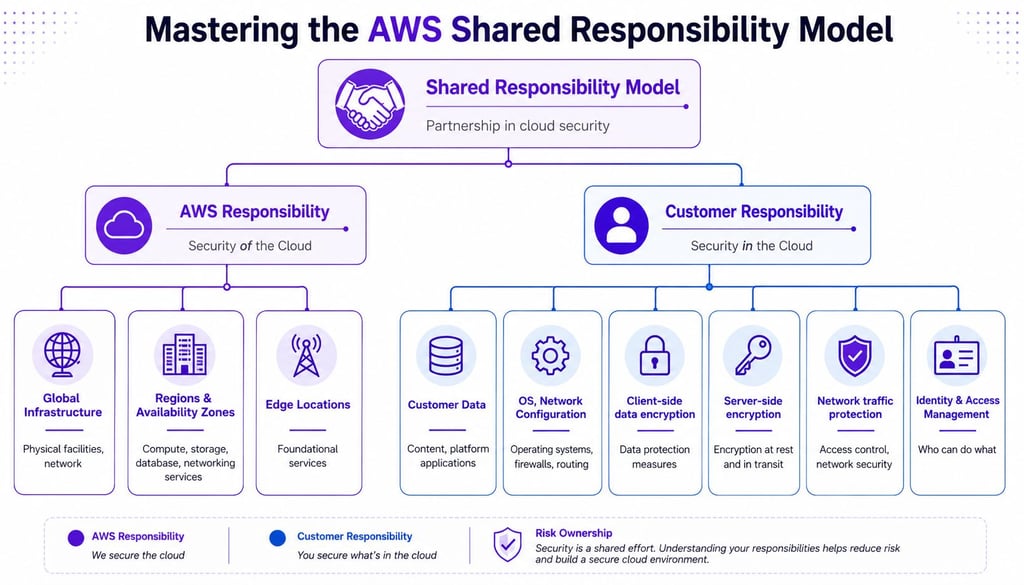
Mastering the AWS Shared Responsibility Model
The AWS shared responsibility model is often explained like a neat division of labor. That framing is too passive. In reality, it's a boundary of risk ownership.
Where AWS stops and your risk starts
AWS secures the cloud infrastructure itself. You still own what runs inside it. A useful analogy is a secure apartment building. AWS controls the building structure, lobby systems, and facility operations. You still choose who gets a key, whether your door is locked, what valuables sit inside, and whether guests can walk freely from room to room.
That distinction matters because many executive teams still assume managed services reduce customer-side exposure by default. They reduce some infrastructure burden. They do not remove responsibility for identity and access management, network configuration, data protection, application security, or logging choices.
In practical terms, your team owns decisions such as:
Who can do what: IAM users, roles, trust relationships, and federated access.
What can talk to what: VPC design, security groups, routing, and internal segmentation.
What gets logged and retained: CloudTrail scope, centralized storage, alerting, and retention discipline.
How data is protected: Encryption choices, key management, access patterns, and recovery controls.
How workloads get deployed: AMIs, containers, CI/CD permissions, and secrets handling.
A simple executive test
Ask one question in every AWS review: If AWS does everything it promises, what failure modes still belong entirely to us?. That question cuts through vague ownership. It usually surfaces the same issues. Teams haven't reviewed trust policies. Engineers can still bypass central access paths. Logging exists but doesn't support investigation. Encryption is enabled in places but key access isn't tightly governed. Container pipelines deploy fast, but no one has mapped who can push, approve, or alter artifacts.
Shared responsibility doesn't reduce your need for governance. It makes governance more important because the speed of change goes up.
What doesn't work is assuming responsibility is covered because a service is “managed.” A managed database still becomes your breach if access controls, secrets, traffic rules, or data handling fail. In cloud security in AWS, strong outcomes come from owning that line clearly and auditing it constantly.
Your Core AWS Defense Controls
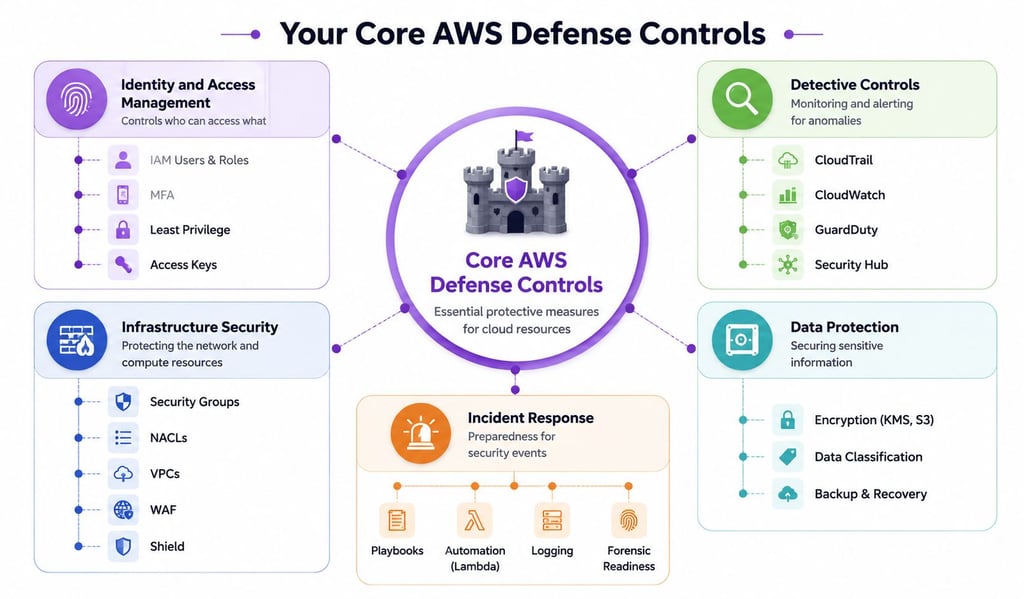
Foundational controls still matter most. The difference between mature and fragile environments usually isn't tool count. It's whether a few core controls work together under real attack conditions.
A useful way to assess cloud security in AWS is to look at five control families. If one is weak, the others absorb pressure they weren't designed to handle.
Identity control comes first
Identity is still the first battlefield. Graylog's AWS security guidance makes the point directly: strictly enforcing the Principle of Least Privilege through federated SSO is critical, because misconfigured IAM policies remain a primary breach vector. The same guidance points to 14-character complex passwords and 90-day rotation cycles from CIS benchmarks as practical ways to reduce the identity attack surface.
The executive question isn't “Do we have IAM?” Every AWS environment has IAM. The question is whether access is controlled through groups and roles, centrally managed through federated SSO, and reviewed based on actual use rather than team assumptions.
Ask your team:
Are privileged actions routed through federated SSO: Or do long-lived IAM users still exist for convenience?
Are permissions assigned to roles and groups: Or have exceptions piled up on individual users?
Are root credentials removed from routine operations: Or does the organization still depend on them during maintenance or incident work?
If this area is loose, attackers don't need much else.
A short technical refresher helps frame the issue:
Network and detection controls need depth
Good network security in AWS doesn't mean “we have security groups.” It means the network layout limits blast radius and gives responders evidence when things go wrong.
Security groups, NACLs, VPC boundaries, WAF, and Shield all matter. But they matter for different reasons. Security groups define reachability. VPC design defines segmentation. WAF helps at exposed application edges. Shield addresses denial-of-service risk. None of them replaces visibility into traffic flows or identity-driven movement.
For detection, the baseline stack should include CloudTrail, CloudWatch, GuardDuty, and Security Hub. The hard question is whether those services are configured to support investigations, not just compliance screenshots.
Logging that can't reconstruct attacker actions is operational theater.
Ask your team for one concrete answer: Can we trace a suspicious role assumption to the API calls, affected resources, and downstream actions without improvising during an incident?
If the answer is vague, the control is weaker than it looks.
Data, containers, and pipeline security decide blast radius
Encryption and key management matter most when another control fails. Use AWS KMS deliberately. Know which teams can use keys, rotate access, and decrypt data through service integrations. “Encrypted at rest” is helpful, but it doesn't protect much if broad IAM permissions let too many identities use the keys.
Container and CI/CD security often decide whether a local compromise becomes an environment-wide incident. In many AWS estates, the build system has more practical power than production admins admit. An attacker who can modify a pipeline, push a container, alter infrastructure code, or inject secrets into a build can bypass a surprising number of downstream controls.
A practical executive checklist looks like this:
For data protection: Are sensitive stores tied to clear key ownership and restricted decrypt paths?
For containers: Are image sources controlled, and can the team prove what entered production?
For CI/CD: Who can approve, alter, or trigger deployments, and how is that monitored?
For incident response: Do playbooks cover cloud-specific evidence collection, role isolation, and credential revocation?
The strongest AWS programs don't overcomplicate this. They keep identities tight, segment networks intentionally, log thoroughly, protect keys carefully, and treat pipelines as privileged systems.
Common Gaps Attackers Love to Exploit
Attackers look for the distance between policy intent and operational reality. In AWS, two gaps appear repeatedly. One sits in IAM. The other sits inside the network.
What doesn't work is treating one scan or one annual assessment as proof of security. AWS changes too quickly. The right model is cyclical: assess, test, remediate, verify, repeat.
From Controls to Compliance and Strategy
Security leaders often separate technical hardening from compliance and strategic planning. That split creates waste. In AWS, the same controls that reduce attack paths also make audits cleaner and board reporting more defensible.
Compliance gets easier when security is real
SOC 2, ISO 27001, and HIPAA readiness usually gets harder when teams build controls for auditors instead of attackers. Evidence becomes fragmented. Ownership gets fuzzy. Exceptions pile up.
The opposite approach works better. If identities are tightly governed, logs support investigations, key access is controlled, change paths are reviewed, and validation proves remediation, compliance usually becomes a documentation exercise built on top of real operating discipline.
That matters at the executive level because audit pain is often a symptom. It usually points to weak control ownership, unclear risk decisions, or inconsistent verification. Strong cloud security in AWS supports both outcomes at once. It reduces exposure and gives the organization cleaner evidence of due care.
A few direct connections are worth emphasizing:
Access governance supports least-privilege and user accountability requirements
Logging and retention support auditability and investigation
Encryption and key management support data protection obligations
Validation exercises support control effectiveness, not just control existence
Strategy needs an operating owner
Many mid-market and growth-stage organizations have capable engineers but still lack a consistent security operating model. That's where strategic leadership matters. Someone has to translate technical findings into business decisions, sequence investments, define risk tolerance, and keep cloud controls aligned with product and infrastructure change.
A virtual CISO model often fills that gap well when the organization doesn't need or can't justify a full-time executive yet. The value isn't just policy writing. It's setting direction, making control ownership explicit, framing risk in business terms, and connecting remediation with compliance milestones, vendor oversight, and board communication. Organizations that need that blend of technical and executive support often look for security leadership and advisory services that connect offensive findings with long-term program design.
The key point is simple. Security strategy should emerge from tested controls, not abstract maturity models.
Building a Defensible Cloud Environment
A defensible AWS environment doesn't come from collecting best practices. It comes from reducing the attacker's usable options. Tight identities, controlled trust, meaningful logging, internal visibility, and repeated validation do that work.
That's the mindset shift CISOs need. Move from checklist security to adversary-focused risk reduction. Test whether permissions are real, not just attached. Treat internal traffic as contested space. Prioritize the remediations that cut off credential abuse and lateral movement first.
Security in AWS isn't finished when controls are deployed. It improves when teams verify those controls under realistic conditions and fix what fails. Organizations that adopt that cycle build resilience the right way, through evidence, not assumption. If you need help assessing or validating your AWS posture, review offensive security and advisory services.
Null Cipher Security helps organizations validate cloud security in AWS through adversary-simulated testing, penetration testing, red teaming, cloud configuration reviews, and executive security advisory. If you want an attacker's view of your real exposure, not another generic checklist, explore Nullciphersecurity


Attached policy reviews miss shadow privilege
Security teams often review what's attached to a user or role and stop there. Attackers don't. They care about effective permissions, meaning what that identity can do once trust relationships, inherited access, service-linked roles, and runtime behavior are considered.
Qualys notes that fewer than 15% of enterprises consistently audit effective permissions. That leaves a large pool of shadow privilege. A role may look acceptable in a static review while still enabling broad real-world access through policy overlap, stale grants, or rare but dangerous actions no one remembers granting.
A practical example is an engineering role with historical permissions to snapshot storage, read secrets for troubleshooting, or pass roles to automation. None of those permissions may be needed today. But if they remain available, an attacker who compromises that role can use legitimate APIs to expand access without dropping obvious malware or touching the perimeter.
What doesn't work is annual IAM cleanup. Cloud environments drift too quickly for that.
Use a different question: Which permissions were used, by whom, and under what pattern? If the team can't answer from runtime evidence, least privilege exists mostly as a design principle, not an enforced state.
Internal traffic isn't trusted traffic
The second blind spot is East-West movement. Many teams invest heavily in internet-facing controls and assume internal VPC traffic is lower risk because it sits behind cloud boundaries. That assumption breaks fast once an attacker gets credentials or lands on a workload.
Qualys also highlights a major visibility gap: 68% of data exfiltration attempts originate from unmonitored East-West traffic. If internal flows are encrypted and unobserved, attackers can move laterally through expected channels while defenders remain focused on ingress and egress choke points.
When defenders call internal traffic “trusted,” attackers hear “uninspected.”
A common attack path is straightforward:
Initial access: The attacker gets an access key, session token, or vendor-linked role.
Discovery: They enumerate services, VPCs, tags, security groups, and reachable systems.
Lateral movement: They pivot through internal services, management paths, or workload-to-workload trust.
Exfiltration: They move data through internal channels that never trigger perimeter-centric alerts.
This is why East-West visibility matters so much. Without it, even strong edge security leaves a large gap after first compromise. The teams that close this gap instrument internal flows, correlate network activity with identity context, and test whether lateral movement gets detected before material data access occurs.
A Prioritized Remediation Playbook
Most AWS security programs already have a long backlog. Adding more recommendations usually doesn't help. Prioritization does.
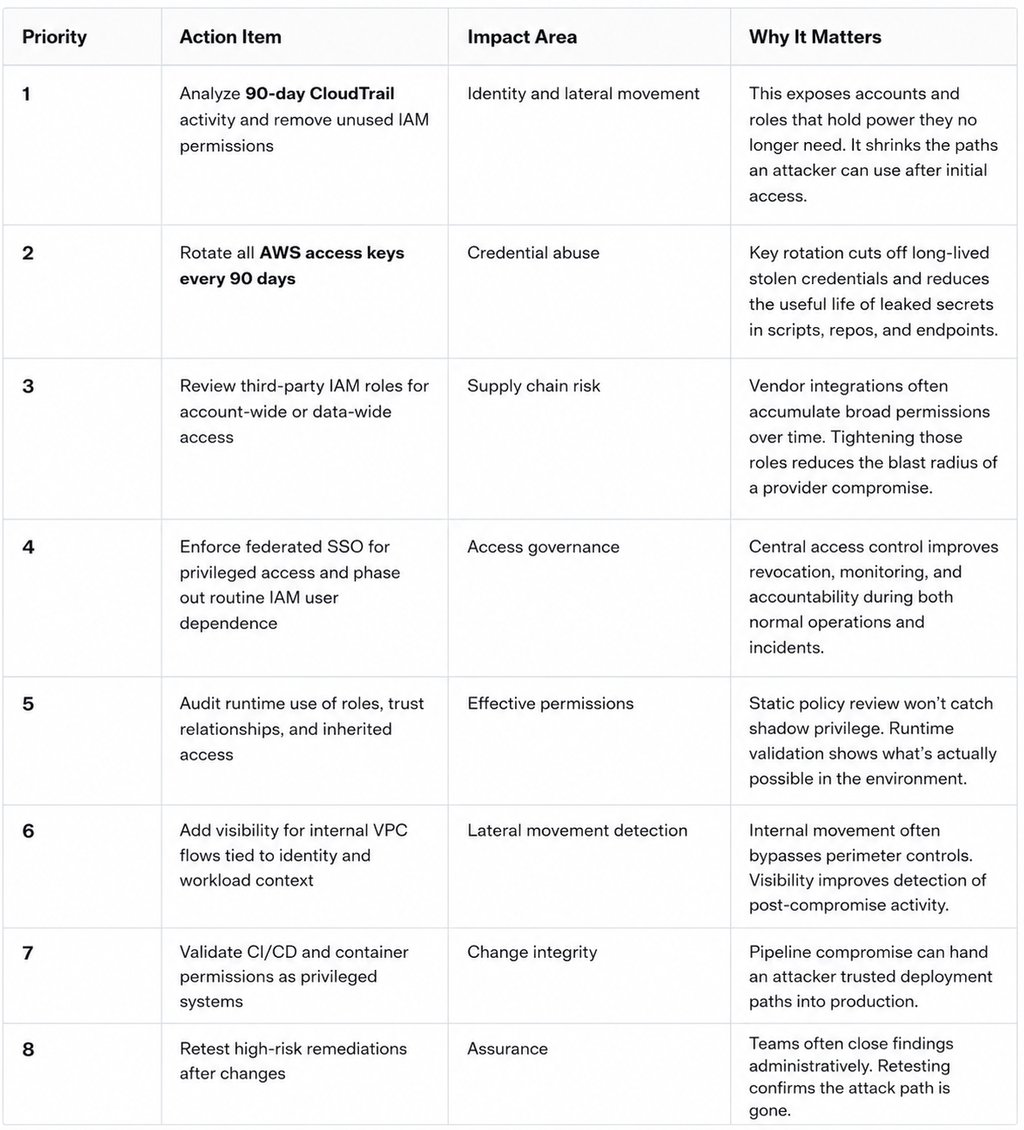
The best remediation choices cut off common attack paths with minimal debate. Start where attackers gain the most advantage: stale privilege and durable credentials. Fidelis highlights two high-impact actions that belong near the top of any AWS roadmap: trim unused IAM user permissions by analyzing 90-day AWS CloudTrail logs and rotate all AWS access keys every 90 days, which immediately invalidates stolen credentials.
AWS Security Remediation Playbook
Permission trimming can break workflows: Teams should phase removals with logging, owner review, and rollback plans.
Key rotation can expose hidden dependencies: That pain is useful. It shows where unmanaged automation still depends on brittle access patterns.
Third-party role reduction can create vendor friction: That's still preferable to account-wide exposure through convenience-based trust.
The 80/20 move is clear. Reduce unnecessary access, shorten credential life, and remove broad trust that no one can justify.
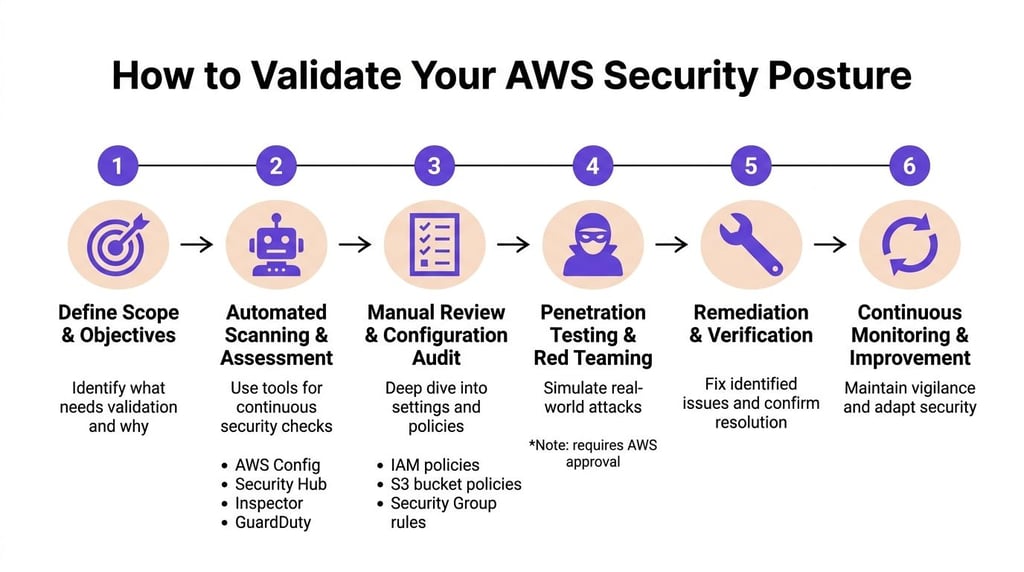
How to Validate Your AWS Security Posture
Controls only matter if they hold under pressure. Validation turns security from assumption into evidence.
Three levels of assurance
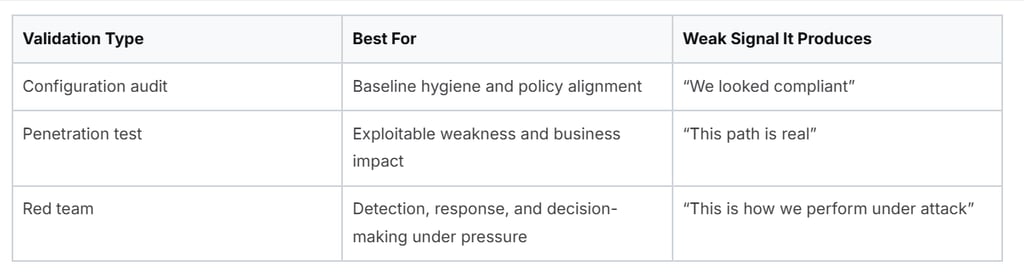
Start with a cloud configuration audit. This checks whether the environment aligns with internal standards, AWS-native control expectations, and frameworks such as CIS. It catches issues like risky bucket policies, exposed security group rules, weak trust policies, and logging gaps. It's efficient, but it doesn't prove exploitability.
Move next to a penetration test. This answers a different question: can an attacker chain the weaknesses into meaningful access? In AWS, that often means testing IAM abuse, trust path escalation, exposed workloads, secret handling, application weaknesses, and post-compromise movement. A strong test produces proof, not just observations. For organizations comparing technical assurance options, penetration testing and vulnerability assessment services provide a useful model for how validation should map findings to exploitable impact.
Then use red teaming when you need to evaluate detection and response, not just exposure. Red teams simulate an adversary with objectives. Can they obtain credentials, move internally, evade monitoring, and reach sensitive systems before your team contains them? Through this process, many organizations discover that controls exist, but workflows fail.
Validation should escalate from “Is it configured?” to “Can it be exploited?” to “Can we catch and stop it?”
What executives should require
Different methods answer different risk questions. That's why mature programs don't pick only one.
A practical decision model looks like this:
Choose configuration audits when you need broad hygiene review across accounts and services.
Choose penetration testing when you need to confirm exploitable paths and prioritize fixes by real impact.
Choose red teaming when you need to measure resilience across people, process, and technology.
For executive oversight, ask for these outputs after each exercise: